Watt’s Law - Power Triangle
By R.W. Hurst, Editor
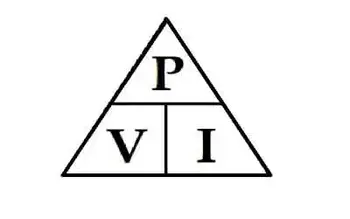
Watt’s Law defines the relationship between electrical power, voltage, and current: power equals voltage multiplied by current. In practical terms, it tells you how much electrical energy a circuit or device is using at any moment.
Watts Law Explained With Examples
This relationship is foundational, but in practice, it matters most when equipment sizing, circuit loading, or heat buildup are involved. Electricians and technicians rarely struggle with the formula itself. Where mistakes usually occur is in understanding what the result actually means for a real system.
Using this relationship, once voltage and current are known, power can be determined quickly. That calculation helps answer very practical questions: Is a conductor adequately sized? Is a breaker being pushed too close to its limit? Is a piece of equipment operating efficiently or being overstressed?
For example, consider a light bulb connected to a circuit. Voltage provides the electrical pressure, current represents the flow of charge through the filament, and power describes how much energy is being converted into light and heat. The wattage printed on the bulb is not an abstract number; it tells you how much energy the bulb consumes every second while operating.
From this equation, engineers can move beyond simple devices and analyze larger systems. In training environments, this is where confusion often appears. Many people focus on memorizing the formula rather than recognizing that power is the result of how voltage and current interact in the real world.
This becomes especially important in data centers, where power density, heat dissipation, and equipment reliability are tightly linked. In these environments, Watt’s Law is used constantly to manage loads across server racks, size power distribution units, and reduce unnecessary energy loss. Small miscalculations can translate into significant operating costs or thermal problems.
Ohm’s Law is often used alongside this principle. While Ohm’s Law explains how voltage, current, and resistance interact, Watt’s Law focuses on the result of that interaction, energy use. Together, they form the basis for analyzing nearly every electrical system, from simple circuits to complex industrial installations.
To fully understand Watt's Law, it helps to explore how voltage and current electricity interact in a typical electrical circuit.
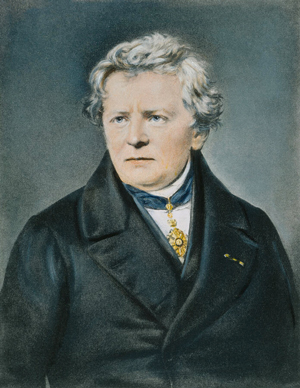
Georg Simon Ohm – German physicist and mathematician (1787–1854), known for Ohm's Law, relating voltage, current, and resistance.
What is Watt's Law and how is it used in electrical circuits?
Watt’s Law is a fundamental principle in electrical engineering that defines the relationship between power, voltage, and current in an electrical circuit. The formula is expressed as:
Power (Watts) = Voltage (Volts) × Current (Amperes)
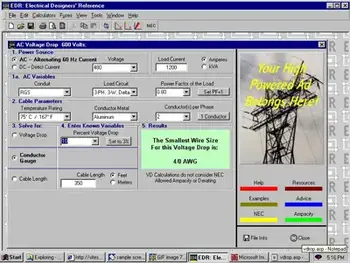
In simpler terms, Watt’s Law states that the electrical power consumed by a device (measured in watts) is the product of the electrical potential difference (voltage) and the current flowing through the circuit. Accurate calculations using Watt’s Law often require a voltage-drop calculator to account for line losses in long-distance wiring. Comparing voltage drop and voltage sag conditions illustrates how slight changes in voltage can have a substantial impact on power output.
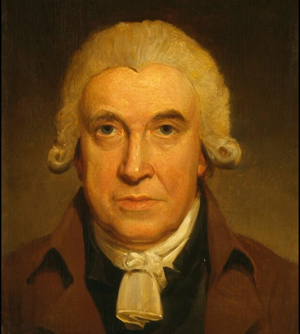
James Watt – Scottish inventor and mechanical engineer (1736–1819), whose improvements to the steam engine led to the naming of the watt (unit of power).
How is it used? Watt’s Law is widely used to determine the amount of power an electrical device or system consumes. This is especially important for designing electrical circuits, optimizing power distribution, and ensuring device efficiency. Here are a few examples of how it’s applied:
-
Electrical Circuit Design: Engineers use it to calculate device power consumption and ensure circuits can handle the expected electrical load. This helps prevent overloads and ensures that the wiring is safe.
-
Power Output Calculations: Use this formula to calculate the power output of a generator, appliance, or device, enabling you to match the right components to your system's requirements.
-
Energy Efficiency: Understanding appliance and device power consumption helps consumers make informed choices, such as selecting energy-efficient options. Devices like wattmeters and watthour meters measure power and energy usage based directly on the principles of Watt’s Law. For a deeper look at how devices like ammeters help measure current, see how their readings plug directly into Watt’s Law calculations.
How is Watt's Law different from Ohm's Law?
Watt’s Law and Ohm’s Law are both fundamental principles in electrical engineering, but they deal with different aspects of electrical systems:
-
Watt’s Law defines the relationship between power, voltage, and current. It focuses on the amount of energy used by a device in a given circuit. The formula is:
Power = Voltage × Current
-
Ohm’s Law defines the relationship between voltage, current, and resistance in a circuit. Ohm’s Law explains how current is affected by voltage and resistance in a circuit. The formula for Ohm’s Law is:
Voltage = Current × Resistance
Key Differences:
-
Focus: It focuses on power, while Ohm’s Law focuses on the flow of electricity in a circuit, particularly how resistance affects current.
-
Watt’s Law is used to determine the amount of power a device is consuming. Ohm’s Law, on the other hand, is used to calculate current, voltage, or resistance in a circuit depending on the other known variables.
-
Applications: It is used when designing systems that require power management, such as calculating device power output or efficiency. Ohm’s Law is used more in analyzing how current behaves in a circuit when different resistive elements are present.
By combining both laws, electrical engineers can gain a comprehensive understanding of how electrical systems function, ensuring that devices operate efficiently and safely. When used with Ohm’s Law, Watt's Law enables engineers to analyze both energy consumption and electrical resistance.

One key area of application is in energy consumption. By understanding the device's voltage and current, engineers can monitor the energy it consumes. This is especially important for managing energy usage in homes, businesses, and power systems. By applying the formula, you can identify inefficient devices and make more informed decisions about energy efficiency.
In renewable energy systems, such as solar panels and wind turbines, this principle plays a critical role in optimizing energy output. Engineers use the formula to calculate the amount of electrical energy generated and distributed. This is crucial for ensuring that power systems operate efficiently and minimize excess energy loss.
Another practical application of this formula is in the automotive industry. It is used to design vehicle charging systems and battery technologies. For example, electric vehicle (EV) charging stations depend on understanding voltage, current, and power to ensure efficient charging times. Engineers use the equation to calculate the charging capacity required for EV batteries, helping to create optimal charging solutions.
In large facilities like data centers, this Watt’s Law formula is used to ensure power distribution is efficient. By applying the relationship between power, voltage, and current, engineers can effectively manage power systems, thereby reducing energy consumption and operational costs. Proper energy management in data centers is crucial, as high power consumption can lead to significant energy costs.
This power formula is indispensable for electrical engineers and technicians. The applications of Watt’s Law span various industries and are used in everything from designing power system wiring to developing renewable energy technologies. By combining Ohm’s Law and this principle, electrical engineers can optimize the performance of electrical components, ensuring energy efficiency and system reliability. Understanding the role of a resistor in a circuit can reveal how power is dissipated as heat, a key concept derived from Watt’s Law.
Finally, visual tools like the Watt's Law triangle are often used to simplify the application of this principle, helping both professionals and students understand how to apply the formula. As technology advances and energy demands grow, this formula remains a key element in electrical engineering, guiding the development of more efficient systems for the future.
Related Articles