Power System Analysis
By William Conklin, Associate Editor
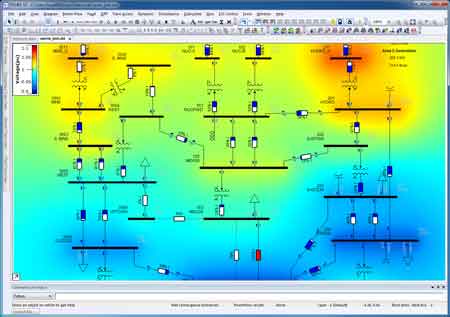
Power system analysis is the discipline of evaluating how electrical networks behave under real operating conditions, enabling engineers to anticipate performance, manage risk, and inform planning and operational decisions. It interprets interactions among voltage, current, power, and impedance across transmission and distribution systems to reveal whether a network will remain stable and reliable under normal and disturbed conditions.
By converting physical infrastructure into mathematical models, power system analysis provides predictive insights that underpin decisions on reliability assessments, protection strategies, and the integration of new technologies, such as variable renewable generation.
These analytical outcomes form the foundation for detailed engineering work, including power system analysis and design engineering practice, in which insights from analysis inform equipment selection, control strategies, and system specifications.
Core Power System Analysis Concepts
Every analytical study begins with an accurate representation of the system. Physical components are converted into mathematical models that reflect real electrical behavior. These models rely on relationships defined by impedance and inductance, allowing engineers to evaluate how energy moves through complex networks without oversimplifying real system behavior.
Engineers use single-line diagrams to visualize how components connect and where constraints may appear, not because they show every detail, but because they clarify power paths and system structure. Engineers often rely on more detailed frameworks for load flow analysis to refine voltage profiles, thermal margins, and power transfer limits under steady-state conditions.
Within the field of power system engineering, analytical studies provide the foundation for design validation, operational planning, and long-term reliability strategy.
Load Flow Investigation
Load flow investigation, often called power flow analysis, evaluates how voltage, current, active power, and reactive power distribute through a system under normal operating conditions. These results determine whether voltages remain within acceptable limits, whether conductors or transformers are overloaded, and how generation shares demand.
Because reactive behavior strongly influences voltage performance, engineers interpret load flow results alongside power factor to identify efficiency losses and stability concerns. Load flow solutions also lay the foundation for later fault and stability studies, making their accuracy critical to subsequent analysis.
Fault Studies and Protective Requirements
Fault studies examine abnormal conditions such as short circuits that impose extreme electrical stress. Short-circuit analysis quantifies fault current magnitude, enabling protective devices to be rated and coordinated correctly. Without precise fault data, breakers may fail to interrupt safely, increasing the likelihood of equipment damage and serious safety hazards.
These studies closely align with the practical understanding of electrical short circuits and provide the analytical basis for protection coordination strategies that limit both damage and outage scope.
Stability and Dynamic Response
Stability investigation evaluates whether a system can recover after a disturbance. Generator trips, line outages, or sudden load changes can introduce oscillations or voltage collapse if margins are insufficient. Transient stability focuses on rapid dynamic events, while small-signal and voltage stability address slower deviations that threaten long-term operation.
Stability performance is closely tied to voltage behavior and to conditions such as voltage sag, which analytical models help engineers predict and mitigate before field problems occur.
Integration Challenges: Renewables and Grid Modernization
Renewable generation introduces variability that traditional systems were not designed to manage at scale. Wind and solar resources affect inertia, frequency response, and voltage regulation, requiring refined analytical methods to anticipate system behavior. As grids incorporate green electricity and distributed generation, power system analysis becomes essential for preserving reliability.
Grid modernization further increases complexity by introducing automation, advanced metering, and distributed energy resources. Analytical frameworks allow planners to evaluate how these technologies interact before they are trusted in operation.
Protection Coordination and Operational Optimization
Protection coordination ensures that faults are cleared quickly and selectively. Coordination studies align relay settings and breaker characteristics so devices operate in the intended sequence. Optimization techniques then build on analytical insight to reduce losses, improve dispatch decisions, and strengthen reliability margins.
Engineers frequently evaluate harmonic effects such as total harmonic distortion and voltage sensitivity using analytical tools to ensure operational improvements do not introduce unintended side effects. Together, these disciplines allow power system analysis to serve as the decision foundation for planning, protection, and operational confidence.
Frequently Asked Questions
How does power system analysis support planning decisions?
Power system analysis allows planners to test future operating scenarios before infrastructure is built or modified. By evaluating voltage profiles, loading limits, and stability margins, engineers can prevent issues such as excessive voltage drop or thermal overload before they affect service.
Why is load flow analysis essential before other studies?
Load flow establishes the steady-state operating condition of a system. Fault and stability studies depend on this baseline. If the load flow solution is inaccurate, subsequent analysis results become unreliable.
How does fault analysis improve safety?
Fault analysis determines the magnitude and distribution of short-circuit currents so that protective devices can safely interrupt faults. This reduces equipment damage and minimizes the risk of uncontrolled electrical energy release.
What role does stability analysis play in renewable integration?
Renewable generation reduces system inertia and alters dynamic response. Stability analysis identifies whether the system can remain synchronized and recover after disturbances when renewable penetration increases.
How does power system analysis relate to voltage problems?
Many voltage issues are linked to reactive power imbalance, impedance characteristics, and loading conditions. Analytical studies reveal how voltage varies across the network, enabling corrective actions to be applied with confidence.
Why is protection coordination part of power system analysis?
Protection coordination depends on accurate fault and system models. Without analytical validation, protective devices may operate out of sequence, increasing outage scope and equipment stress.