Understanding Current
By R.W. Hurst, Editor
Current is the flow of charge through a conductor driven by voltage. Knowing what controls current helps prevent overheating, select protection devices, and interpret field measurements accurately on site daily.
Essential Guide to Current for Electricians
Current is best described as the flow of charge, or as the charge moving. Electrons in motion make up an electric current. This electric current is usually referred to as “current” or “current flow,” no matter how many electrons are moving. Current is a measurement of the rate at which a charge flows through some region of space or a conductor. The moving charges are the free electrons found in conductors, such as copper, silver, aluminum, and gold. The term “free electron” describes a condition in some atoms where the outer electrons are loosely bound to their parent atom. These loosely bound electrons can be easily motivated to move in a given direction when an external source, such as a battery, is applied to the circuit. These electrons are attracted to the positive terminal of the battery, while the negative terminal is the source of the electrons. A greater amount of charge moving through a conductor in a given amount of time translates into a higher current. For a concise overview of how moving charges create practical circuits, see this guide to current electricity for additional context.
The System International unit for current is the Ampere (A), where
That is, 1 ampere (A) of current is equivalent to 1 coulomb (C) of charge passing through a conductor in 1 second(s). One coulomb of charge equals 6.28 billion electrons. The symbol used to indicate current in formulas or on schematics is the capital letter “I.” To explore the formal definition, standards, and measurement practices, consult this explanation of the ampere for deeper detail.
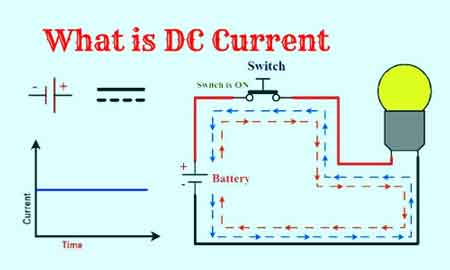
When the current flow is in one direction, it is called direct current (DC). Later in the text, we will discuss the form of current that periodically oscillates back and forth within the circuit. The present discussion will focus solely on the use of direct current. If you are working with batteries or electronic devices, you will encounter direct current (DC) in most basic circuits.
The velocity of a charge is actually an average velocity, called the drift velocity. To understand the idea of drift velocity, think of a conductor in which the charge carriers are free electrons. These electrons are always in a state of random motion similar to that of gas molecules. When a voltage is applied across a conductor, an electromotive force generates an electric field within it, and a current is established.
The electrons do not move in a straight direction but undergo repeated collisions with other nearby atoms. These collisions usually knock other free electrons from their atoms, and these electrons move on toward the positive end of the conductor with an average velocity called the drift velocity, which is relatively slow.
To understand the nearly instantaneous speed of the current's effect, it is helpful to visualize a long tube filled with steel balls, as shown in Figure 10-37. It can be seen that a ball introduced at one end of the tube, which represents the conductor, will immediately cause a ball to be emitted at the opposite end of the tube. Thus, electric current can be viewed as instantaneous, even though it is the result of a relatively slow drift of electrons. To understand the foundational concepts connecting drift velocity to circuit behavior, review this basic electricity primer to reinforce the fundamentals.
Current is also a physical quantity that can be measured and expressed numerically in amperes. Electric current can be compared to the flow of water in a pipe. It is measured as the rate at which a charge flows past a given point in a circuit. Current in a circuit can be measured if the quantity of charge "Q" passing through a cross-section of a wire in a time "t" (time) can be measured. The current is simply the ratio of the charge quantity to the time. Understanding current and charge flow also clarifies how circuits deliver electrical energy to perform useful work.
Electrical current is essentially the flow of electric charge. It can take either the form of a sudden discharge of static electricity, such as a lightning bolt or a spark between your finger and a ground light switch plate. More commonly, though, when we speak of current, we mean the controlled form of electricity produced by generators, batteries, solar cells, or fuel cells. A helpful overview of static, current, and related phenomena is available in this summary of electricity types for quick reference.
We can think of the flow of electrons in a wire as the flow of water in a pipe, except that the pipe is always full. If the valve at one end of the pipe is opened to let water in, one doesn't have to wait for it to make its way to the other end. We get water out of the other end almost instantaneously because the incoming water pushes the water that's already in the pipe toward the end. This is what happens with electrical current in a wire. The conduction electrons are already present in the wire; we just need to start pushing electrons in one end, and they will flow out of the other end instantly. In household power systems, that push on conduction electrons alternates in direction as alternating current (AC) drives the flow with a time-varying voltage.

Current Formula
Current is the rate of flow of negatively-charged particles, called electrons, through a predetermined cross-sectional area in a conductor.
Essentially, the flow of electrons in an electric circuit leads to the establishment of current.
q = relatively charged electrons (C)
t = Time
Amp = C/sec
Often measured in milliamps, mA