Electricity Prices Explained


Electricity Prices

Electricity prices reflect tariffs, kWh rates, time-of-use schedules, peak demand charges, and grid congestion, driven by generation costs, transmission losses, and load profiles in power systems and industrial electrical engineering.


The Complete Guide to Electricity Prices

Electricity prices, or rates, are usually determined by electric utilities and the governmental organizations that oversee them. The fees an electric utility company charges its customers for service aer based on electricity prices set by government, except in the case where they cost electricity prices on a deregulated basis. In that case, electricity prices are determined by marketplace factors such as supply and demand. Electric utility companies charge their customers different rates, depending on the type of customer, the kind of contract, and on the customer's needs. Electricity Prices bill energy on the kwh basis of the individual customer's rate, the level of consumption, and other charges, such as taxes and fuel adjustments. This is how electricity billed. For a deeper breakdown of typical rate components, resources like electricity cost guides explain line items and surcharges clearly.

That collection of rates is called a tariff. The power tariff is designed to provide the privately owned electric utility with enough income to allow investors to earn a cash return and cover operation and maintenance costs. Most of the larger utilities operate as regulated franchises, meaning that the prices they charge are subject to public review, often by a State public utility commission. In competitive markets, customers may choose an electricity supplier while the utility still handles delivery services and billing oversight.

Publicly owned electric utilities are nonprofit, local government agencies established to provide service to their communities and nearby consumers at cost, returning excess funds to the consumer in the form of community contributions, more economic and efficient facilities, and lower power rates. To meet these community objectives, public power agencies plan their electricity supply over multiyear horizons to manage risk and affordability.

Publicly owned electric utilities (which number approximately 2,000) include municipals, public power districts, State authorities, irrigation districts, and other State organizations. Some of these organizations also own or contract for electricity generation assets to enhance self-sufficiency and rate stability.

There are approximately 900 cooperative electric utilities in the United States currently doing business in 47 States. These utilities are owned by their members and are established to provide power to those members. Because member education supports better usage decisions, many cooperatives provide primers on what electricity is and how it is measured on bills.

Average retail Electricity prices of power are calculated by dividing utility revenue by retail sales. The resulting measurement is the cost, or average revenue per kilowatthour, of power sold. (A kilowatthour is equal to one watt of power supplied to an electric circuit steadily for 1,000 hours.) Electric utilities usually offer three primary classes of service: residential, commercial, and industrial. The average price per kilowatthour for residential consumers is generally higher than for any other sector due in part to higher costs associated with serving many consumers who use relatively small amounts of power. In Ontario, the industrial sector has the lowest energy prices and energy bills rates every month due to the economies of serving a few consumers who use relatively large amounts of electricity. Understanding the distinction between energy in kilowatthours and instantaneous electricity power demand helps customers interpret peak charges and capacity fees. Regional consumption patterns, including trends in electricity demand in Canada, can influence wholesale prices and cross-border power flows affecting local rates.
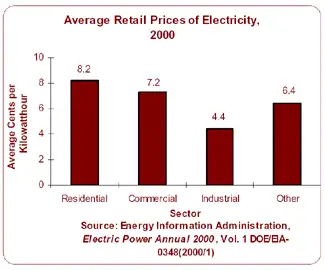

 

average retail


Related Articles

Related News

Electricity Generator

An Electricity generator converts mechanical energy to electrical power via electromagnetic induction, using a prime mover, an alternator, a stator, and a rotor, delivering a regulated AC/DC output, high efficiency, and stable voltage and frequency.   How an Electricity Generator Works Electricity generators operate on a simple principle: when mechanical motion disturbs a magnetic field, it sets electrons in motion, producing usable electrical output. When a conductor moves through a magnetic field, electrons begin to drift, and that simple idea forms the basis of every generator in use today. Whether the machine is part of a wind turbine, a diesel unit…
View more

Choose The Right Conductor of Electricity

Conductor of electricity describes materials with high electrical conductivity, enabling current flow via free electrons or ions under voltage, such as copper, silver, and aluminum, used in wires, busbars, grounding, and power distribution systems.   How Electrical Conductors Work A conductor of electricity is a material that allows electric charges to flow through it with little or no resistance. Copper, aluminum, silver, gold, and nickel are some of the most common conductive materials used in electrical engineering. Conductivity is affected by several factors, such as the material's composition, temperature, and impurities. Conductors are distinguished from insulators, which are materials that…
View more

Electromagnetic Induction

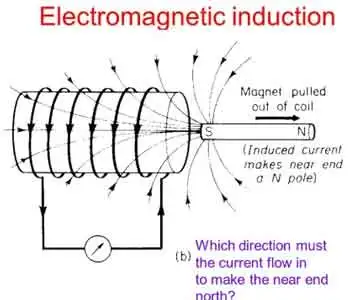
Electromagnetic induction is the process of generating electric current by changing a magnetic field, forming the basis for transformers, generators, and electric motors in power generation and energy conversion systems.   The Complete Guide to Electromagnetic Induction Its underlying principles, Faraday's Law and Lenz's Law, explain the phenomena occurring when magnetic fields interact with conductors. At the same time, its various applications, such as electric generators, transformers, induction heating, and wireless charging, have revolutionized our daily lives. As we continue to explore and understand this intricacy, we can look forward to even more innovations and advancements in electricity and magnetism.…
View more

Electric Power Systems Explained

Electric power systems coordinate generation, transmission, and distribution using grids, substations, protection relays, and SCADA to maintain reliability, stability, power quality, efficient load flow, and renewable integration.   Overview: Electric Power Systems Electric power systems form the backbone of modern society, quietly enabling everything from lighting and communications to industry, transportation, and healthcare. While often taken for granted, these systems are among the most complex engineered networks in existence. They must deliver power continuously, respond instantly to disturbances, and adapt to changing demand while meeting growing expectations for sustainability and resilience. Readers new to core concepts can review what electricity…
View more

Saving Electricity and Electrical Energy

Saving electricity through energy efficiency, power factor correction, load balancing, and demand response integrates smart meters, VFDs, and SCADA to cut losses, optimize voltage, and improve grid reliability in industrial and commercial systems.   Principles of Saving Electricity Saving electricity becomes an increasingly important issue the more the cost of power increases. There is no such thing as cheap electricity. That is a basic fact in today's world of increasing costs for all forms of energy. It's a common fact that vast amounts of electric power are wasted every year in the world, mostly in areas where power is cheap and…
View more

Electrical Units Explained

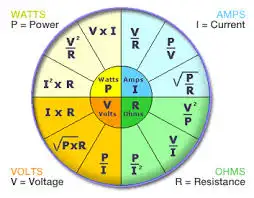
Electrical units determine whether a decision is accurate or dangerously wrong. Every voltage rating, current measurement, resistance value, and power calculation depends on using the correct unit in the correct context. When units are misunderstood or misapplied, equipment is mis-sized, protection is mis-coordinated, and safety margins quietly disappear. Electrical units measure voltage, current, resistance, and power in systems, but their real purpose is not description; it is judgment. Engineers rely on them to verify conductor loading, technicians use them to confirm operating conditions, and facility managers depend on them to assess energy use and system reliability. A single unit error…
View more

Sign Up for Electricity Forum’s Newsletter

Stay informed with our FREE Newsletter — get the latest news, breakthrough technologies, and expert insights, delivered straight to your inbox.

Electricity Today T&D Magazine Subscribe for FREE

Stay informed with the latest T&D policies and technologies.
  • Timely insights from industry experts
  • Practical solutions T&D engineers
  • Free access to every issue

Live Online & In-person Group Training

Advantages To Instructor-Led Training – Instructor-Led Course, Customized Training, Multiple Locations, Economical, CEU Credits, Course Discounts.

Request For Quotation

Whether you would prefer Live Online or In-Person instruction, our electrical training courses can be tailored to meet your company's specific requirements and delivered to your employees in one location or at various locations.