Transformer Insulating Oil
By Frank Baker, Technical Editor
Substation Maintenance Training
Our customized live online or in‑person group training can be delivered to your staff at your location.

- Live Online
- 12 hours Instructor-led
- Group Training Available
Download Our OSHA 3875 Fact Sheet – Electrical PPE for Power Industry Workers
- Follow rules for rubber gloves, arc-rated PPE, and inspection procedures
- Learn employer obligations for testing, certification, and training
- Protect workers from arc flash and electrical shock injuries
Transformer insulating oil provides electrical insulation, arc suppression, and dielectric separation in liquid-filled power transformers. Its chemical stability, dielectric strength, moisture tolerance, and fire performance determine how reliably solid insulation can withstand operating voltage.
Transformer Insulating Oil in Modern Power Transformers
Transformer insulating oil primarily serves to maintain electrical separation within high-voltage equipment. By filling microscopic gaps between energized components, it prevents ionization, suppresses partial discharge, and preserves dielectric coordination between liquid and solid insulation systems.
Unlike structural insulation materials, oil adapts to complex geometries and irregular clearances. This adaptability allows designers to achieve compact insulation systems while maintaining electrical safety margins across a wide voltage range.
Insulating oil should therefore be understood as an electrical insulation material first, and a thermal medium only by consequence of its physical presence within the transformer.
Why insulating oil governs electrical stability
The primary purpose of insulating oil is to sustain dielectric strength under continuous electrical stress. Its molecular composition determines how effectively it resists ionization, absorbs transient electrical energy, and restores insulation margins after switching or fault disturbances.
Dielectric coordination depends on the oil maintaining low moisture content, chemical stability, and resistance to contaminant intrusion. When those conditions are preserved, solid insulation layers operate within predictable stress limits.
The relationship between oil and solid insulation is explored further in transformer insulation, where insulation coordination principles are examined in greater detail.
Electrical Transformer Maintenance Training
Substation Maintenance Training
Request a Free Training Quotation
Electrical stability over service life
Insulating oil does not provide permanent electrical protection by default. Its insulating capability depends on maintaining chemical and physical integrity. Oxidation byproducts, dissolved moisture, and particulate contamination gradually reduce dielectric margins if not controlled.
Test Your Knowledge About Utility Transformers!
Think you know Utility Transformers? Take our quick, interactive quiz and test your knowledge in minutes.
- Instantly see your results and score
- Identify strengths and areas for improvement
- Challenge yourself on real-world electrical topics
For this reason, insulating oil is evaluated not only as a fluid but also as a long-term insulation component within the transformer insulation system.
Its role is therefore governed by material performance rather than by circulation or cooling behavior.
Thermal influence as a secondary function
Although insulating oil does contribute to heat movement, its defining value lies in electrical insulation. Thermal properties such as viscosity and heat capacity are important only to the extent that they support insulation stability.
Uneven thermal exposure accelerates insulation aging in solid materials, which is why oil quality must remain consistent even when thermal loading varies across transformer zones.
Thermal system design itself is addressed separately in transformer cooling, where circulation geometry and heat transfer paths are evaluated.
Types of Transformer Insulating Oil
Insulating oils are selected primarily by their dielectric, chemical, and fire-safety characteristics.
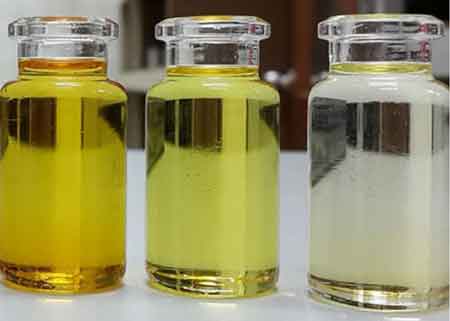
Mineral oil remains widely used because it offers reliable dielectric strength and economic availability. Synthetic esters provide higher fire resistance, improved biodegradability, and strong oxidation stability. Silicone oils serve specialized high-temperature and fire-critical environments.
Each oil family represents a different balance between electrical insulation performance, environmental responsibility, and fire risk tolerance.
From a materials perspective, insulating oil belongs to the broader group of liquids discussed in dielectric fluid behavior and classification.
Mineral, ester, and silicone oils
Mineral oil continues to dominate legacy installations because it offers consistent dielectric behavior and well-established performance history.
Synthetic esters are increasingly adopted where fire safety and environmental compliance carry higher priority.
Silicone oils support niche applications that require exceptional thermal resilience and arc-suppression capability.


No oil type is universally superior. Each serves a specific insulation and safety objective within transformer system design.
Oxidation and long-term behavior
Oxidation is a chemical limitation of insulating oil rather than an operational process. As oxidation advances, acids and sludge form, reducing dielectric strength and contaminating solid insulation interfaces.
Strong oxidation stability delays this process and preserves dielectric margins over extended service intervals.
Oxidation control, therefore, protects insulation performance first and transformer reliability second.
Safety and environmental responsibility
Modern insulating oil selection increasingly reflects fire performance and environmental impact. High fire point fluids reduce containment requirements and improve operational safety. Biodegradable fluids reduce long-term environmental exposure. Oil condition also supports broader asset strategies, such as those described in power transformers health check programs.
These considerations now influence insulating oil choice as strongly as dielectric strength.
Insulating oil as a system partner
Insulating oil should be considered part of the insulation system, not merely a supporting liquid. It operates alongside paper, pressboard, and composite materials to maintain electrical separation under continuous stress.
When insulating oil remains stable, insulation systems age predictably. When oil degrades, insulation margins narrow and system interpretation becomes uncertain.
Transformer insulating oil is therefore not simply a dielectric fluid. It is an insulation system material whose chemical and electrical stability directly governs transformer reliability. At a system level, insulating oil performance ultimately contributes to the reliability expectations placed on power transformers in transmission and distribution networks.
Related Articles