Arc Flash vs Arc Blast: What's the Difference?
By William Conklin, Associate Editor
NFPA 70E Training
Our customized live online or in‑person group training can be delivered to your staff at your location.
- Live Online
- 6 hours Instructor-led
- Group Training Available
Download Our OSHA 4475 Fact Sheet – Being Aware of Arc Flash Hazards
- Identify root causes of arc flash incidents and contributing conditions
- Apply prevention strategies including LOTO, PPE, and testing protocols
- Understand OSHA requirements for training and equipment maintenance
Electrical professionals know that how a hazard is defined determines how it is controlled. In energized work, confusing arc flash with arc blast is not just a terminology issue. It directly affects how tasks are justified, how protections are selected, and how exposure is managed. Arc flash is a thermal hazard. Arc blast is a mechanical hazard. They often occur together, but each demands different forms of attention long before any calculation is performed or PPE is selected.
Why Distinguishing Arc Flash vs Arc Blast Matters
When arc blast is treated as merely part of arc flash, risk planning quietly narrows. Burn protection becomes the dominant concern, while blast forces fade into the background. That imbalance influences how teams justify energized work, where they stand, how they approach equipment, and what controls they consider necessary. Recognizing the difference early changes those decisions. It shifts focus from reacting to calculations toward shaping safer work conditions from the start.
Distance remains one of the few controls that reduces both thermal and mechanical exposure, which is why the concept of the arc flash boundary functions as a practical decision line rather than a theoretical calculation.
What an Arc Flash Is
An arc flash occurs when electrical current leaves its intended conductive path and travels through air to another conductor or to ground. The result is an intense release of thermal energy, bright light, and molten metal. Temperatures rise instantly to levels capable of igniting clothing and causing severe burns in fractions of a second.
Arc-flash protection is built on understanding this thermal exposure. Incident energy values, labels, boundaries, and clothing ratings all exist to reduce burn severity at a defined working distance. Thermal risk is quantified through incident energy, but blast forces remain a planning hazard that must be addressed through positioning and task justification rather than formulas.
Electricity Today T&D Magazine Subscribe for FREE

- Timely insights from industry experts
- Practical solutions T&D engineers
- Free access to every issue
Because these effects can be calculated and categorized, they have become the primary focus of modern electrical safety programs.
What an Arc Blast Is
An arc blast is the pressure wave produced when an electrical arc rapidly heats and expands the surrounding air. That expansion produces a concussive force capable of opening enclosure doors, projecting debris, and throwing workers off balance.
Arc blast injuries are mechanical rather than thermal. They include broken bones, head injuries, internal trauma, and hearing damage. Arc-rated clothing offers little protection against these forces, which is one reason arc blast risk is frequently underestimated. Selecting protection based only on arc flash PPE category can unintentionally narrow attention to burn protection while leaving blast exposure insufficiently considered.
How Arc Flash and Arc Blast Occur Together
In most high-energy faults, arc flash and arc blast occur almost at the same moment. The same event that releases heat also drives the pressure wave. Yet the injury mechanisms differ, so the controls must also differ.
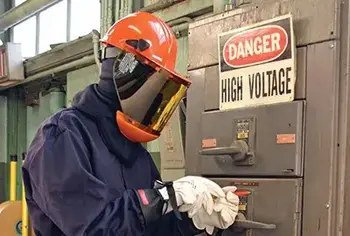
Arc flash controls emphasize thermal protection and working distance. Arc blast controls depend more on enclosure design, system fault current, task positioning, and whether the work truly needs to be performed energized. A worker can meet every arc flash PPE requirement and still be seriously injured by blast forces if these other factors are ignored.
Facilities that rely on a formal arc flash study gain better insight into thermal risk, but still must apply professional judgment to manage blast consequences.
Understanding what causes arc flash also helps explain why pressure effects develop at the same time as thermal release.
What Standards Actually Expect
Neither NFPA 70E nor CSA Z462 provides a specific formula for arc blast pressure, but both require employers to consider all reasonably foreseeable hazards associated with electrical work. That includes pressure effects, flying debris, and physical displacement of workers.
In the United States, OSHA approaches this expectation through general duty and electrical safety enforcement rather than numerical blast limits. The intent is not to calculate every force, but to recognize hazards and control them through planning, supervision, and work practices. Many incident reports describe severe injury patterns consistent with electrical arc blast even when burn protection was properly selected.
When servicing or maintenance is involved, effective lockout tagout practices eliminate both arc flash and arc blast exposure altogether.
Why Arc Blast Is Often Overlooked
Training programs tend to emphasize what is easiest to quantify. Burn severity fits neatly into charts and categories. Blast forces do not. As a result, arc blast is often treated as an abstract concept rather than a practical hazard.
This creates a false sense of security. When attention centers only on arc-rated clothing and incident energy, workers may believe they are fully protected, when in fact they are protected only from one part of the hazard.
Decision Framework for Real Facilities
Understanding the difference between arc flash and arc blast sharpens everyday decisions. It affects whether work is justified as energized, where a person stands, how long they remain exposed, and what controls are truly effective. Facilities that understand this distinction tend to plan work more deliberately and push harder for de-energization. Facilities that do not often learn the difference are forced to learn it only after an incident.
Arc flash burns. Arc blast strikes. Both can occur together, and both must be addressed. Recognizing the difference improves risk assessment, strengthens decision-making, and aligns real-world practice with the intent of NFPA 70E, CSA Z462, and OSHA. Most importantly, it reduces injuries that occur not because hazards were unknown, but because they were misunderstood.
Test Your Knowledge About Arc Flash!
Think you know Arc Flash? Take our quick, interactive quiz and test your knowledge in minutes.
- Instantly see your results and score
- Identify strengths and areas for improvement
- Challenge yourself on real-world electrical topics

