Arc Flash PPE Requirements: Interpretation, Selection, and Risk Judgment
By Frank Baker, Associate Editor
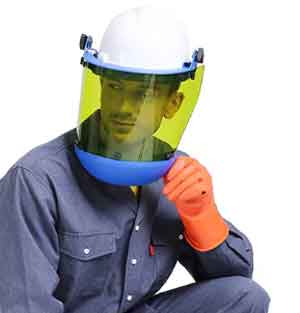
NFPA 70E Training
Our customized live online or in‑person group training can be delivered to your staff at your location.
- Live Online
- 6 hours Instructor-led
- Group Training Available
Download Our OSHA 3875 Fact Sheet – Electrical PPE for Power Industry Workers
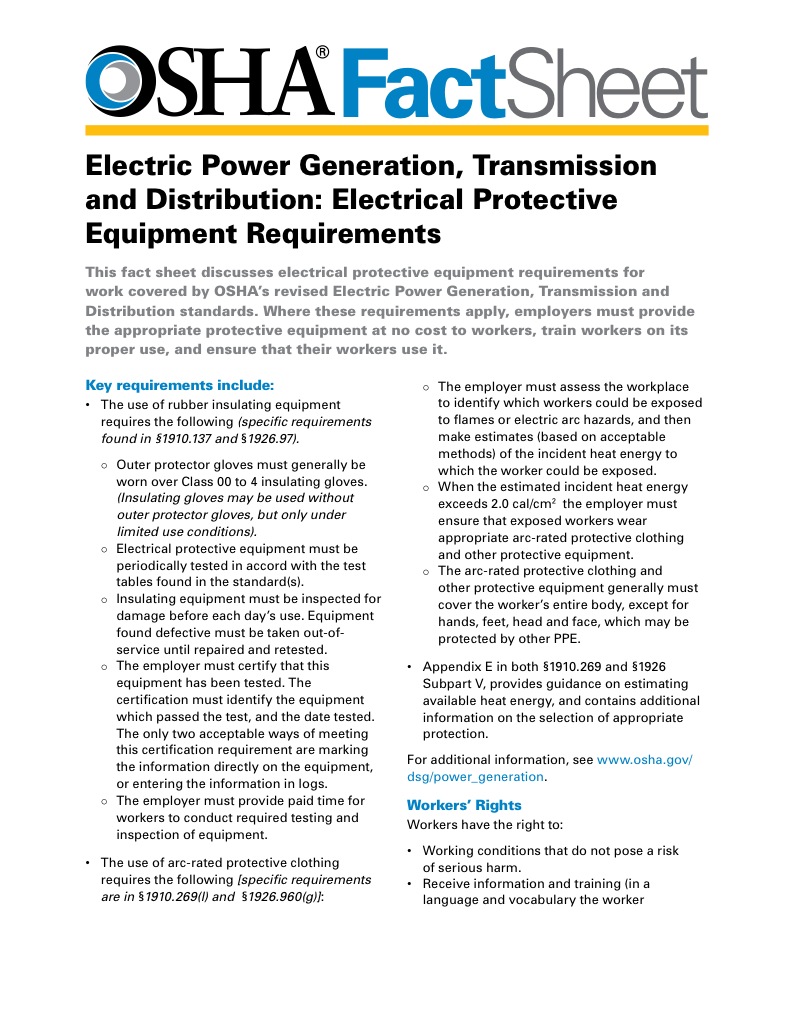
- Follow rules for rubber gloves, arc-rated PPE, and inspection procedures
- Learn employer obligations for testing, certification, and training
- Protect workers from arc flash and electrical shock injuries
Arc flash PPE requirements define how protective clothing and equipment must be selected to align with incident energy and task conditions to limit burn injuries during energized electrical work. What they do not define is how professionals should interpret those requirements when real systems, real equipment, and real uncertainty enter the decision.
That gap is where most PPE failures occur.
In practice, PPE is selected before a panel is opened, not after an arc occurs. Once an arc flash begins, there is no opportunity to react. The clothing and equipment worn at that moment often determine whether injuries are survivable. For that reason, arc flash PPE requirements are not administrative rules. They are operational controls that connect engineering conditions to human survival.
This page exists to address how those requirements are interpreted, applied, and misapplied in real work.
For formal compliance authority, refer to NFPA 70E Arc Flash PPE Requirements
For visual confirmation of categories and protection ranges, use the Arc Flash PPE Requirements Chart
Why Arc Flash PPE Requirements Fail in Practice
Most arc flash injuries are not caused by a lack of PPE. They are caused by PPE that no longer matches the hazard.
Systems change. Fault current changes. Protective device settings change. Equipment ages. Modifications accumulate. Yet PPE decisions often remain anchored to assumptions that are no longer true. When that happens, protection becomes symbolic rather than functional.
Under-protection is far more dangerous than over-protection. Excess PPE may reduce comfort or productivity. Insufficient PPE can permanently injure or kill.
Arc flash PPE requirements exist to prevent that mismatch, but only when they are tied to the current system reality. These realities explain why arc flash PPE requirements must be interpreted through system conditions, not memorized as fixed category rules.
Sign Up for Electricity Forum’s Arc Flash Newsletter
Stay informed with our FREE Arc Flash Newsletter — get the latest news, breakthrough technologies, and expert insights, delivered straight to your inbox.
Request a Free Training Quotation
How Arc Flash PPE Requirements Are Determined
NFPA 70E recognizes two acceptable methods for determining required PPE.
The first is incident energy analysis. This method calculates the amount of thermal energy that could reach a worker at a defined working distance. The result allows PPE to be selected with a measurable margin of protection. Where systems are complex or exposure is high, this method provides the clearest alignment between hazard and clothing.
The second method uses task-based PPE tables. These associate common tasks with assumed exposure ranges and corresponding PPE levels. When conditions match the assumptions behind the tables, this approach can be effective. When conditions drift, the tables quietly lose validity.
The critical distinction is not which method is used. The distinction is whether the method still reflects reality.
Tables simplify decisions. They do not remove responsibility.
Why PPE Categories Create False Confidence
PPE categories are useful shorthand, but they often create the illusion of precision.
Protection does not increase in neat steps. It escalates continuously as incident energy rises. Category boundaries exist for communication, not for safety by themselves.
At lower exposures, arc-rated shirts and pants with face protection may be sufficient. As exposure increases, protection expands into layered garments, arc-flash hoods, and extended neck and head coverage. At higher levels, fully enclosed suits are required, such as those used in 40 Cal Arc Flash Suit applications.
When work requires this level of protection, it is often a signal that energized work itself should be questioned. PPE requirements are not designed to justify risk. They are designed to reveal it.
Category numbers are not the hazard. Incident energy is.
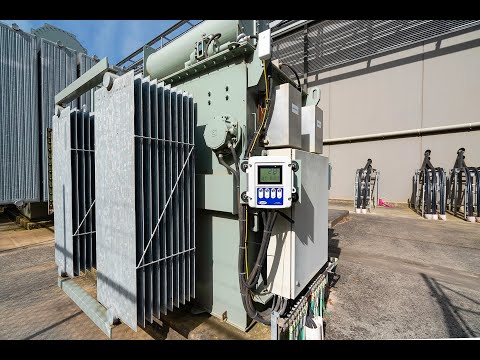
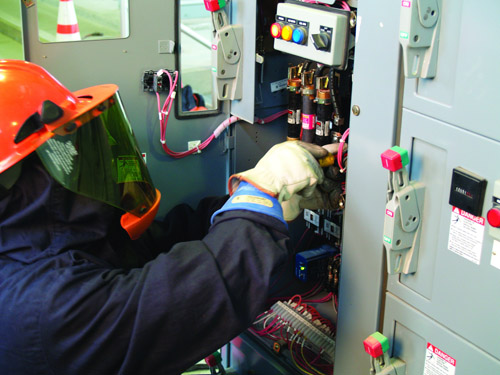
This is especially important on systems such as 480V arc flash equipment, where small system changes can produce large exposure differences.
PPE as a Protective System
Arc flash PPE requirements apply to complete protective systems, not individual garments.
A high-rated jacket does not compensate for inadequate face, hand, or head protection. Gloves must address both thermal and shock hazards. Head protection must manage radiant heat and pressure. Clothing layers must maintain continuous coverage through movement.
Protection only works when the system works together.
This is why PPE selection must be coordinated with the applicable arc flash boundary, which defines the distance at which injury becomes possible. Visualizing that relationship is easier using the Arc Flash Boundary Chart.
High-Incident-Energy PPE Decisions
When incident energy approaches or exceeds 40 cal/cm², PPE selection becomes a system-engineering decision rather than a clothing decision.
Protection typically includes a hooded suit system, layered garments, arc-rated gloves combined with rubber insulating gloves, and accessories selected to prevent any gap in coverage. Each component reduces exposure, but no single component provides complete protection on its own.
Before any PPE is selected, workers rely on the information shown on the arc flash warning label, which frames the exposure context and task conditions that drive the decision.
This layered approach reinforces a fundamental truth: effective arc flash protection depends on coordination, not ratings alone.
The Role and Limits of PPE Charts
PPE charts are valuable tools when they reflect current system conditions. They promote consistency, training, and communication.
But charts are not safety systems. They are summaries.
Their reliability depends entirely on whether the assumptions behind them remain valid. When charts are treated as authority rather than reference, risk increases rather than decreases. This is why charts must always be supported by an ongoing Arc Flash Risk Assessment. Charts support decisions. They do not replace judgment.
Electricity Today T&D Magazine Subscribe for FREE

- Timely insights from industry experts
- Practical solutions T&D engineers
- Free access to every issue
Compliance Versus Protection
Meeting PPE requirements involves more than selecting a rating.
Garments must remain arc-rated, properly labelled, maintained, and free from contamination or damage. Improper laundering, aging fabric, or physical wear can significantly reduce protection even when ratings remain unchanged.
Face, neck, and upper-torso protection deserve particular attention. Many severe arc flash injuries involve these areas. PPE requirements only work when those regions are treated as integral parts of the protective system.
Responsibility and Ongoing Review
Employers are responsible for ensuring that PPE decisions are justified, documented, and communicated clearly. Workers must understand not only what PPE is required, but why it is required for a specific task.
When PPE decisions are explained in context, compliance improves, and shortcuts decrease, particularly when workers are formally recognized as Qualified Electrical Workers.
Arc flash PPE requirements are not static. Standards evolve. Systems change. Exposure conditions shift. Organizations that treat PPE selection as a living process identify gaps before they become injuries.
Applying Arc Flash PPE Requirements Effectively
Effective PPE application integrates hazard assessment into job planning. Protection is selected based on current conditions, reviewed when systems change, and reinforced through training and supervision.
Arc flash PPE requirements exist to align protection with reality. When they are applied deliberately, they reduce risk in measurable ways. When they are treated as fixed rules or simplified shortcuts, they can fail silently.
The difference lies in how carefully they are understood and applied.
Related Articles
Use these to extend judgment and consequence awareness, not to repeat compliance content:
