Arc Flash Boundary Chart - Safe Approach Distances
By R.W. Hurst, Editor
NFPA 70E Training
Our customized live online or in‑person group training can be delivered to your staff at your location.

- Live Online
- 6 hours Instructor-led
- Group Training Available
Download Our OSHA 4474 Fact Sheet – Establishing Boundaries Around Arc Flash Hazards
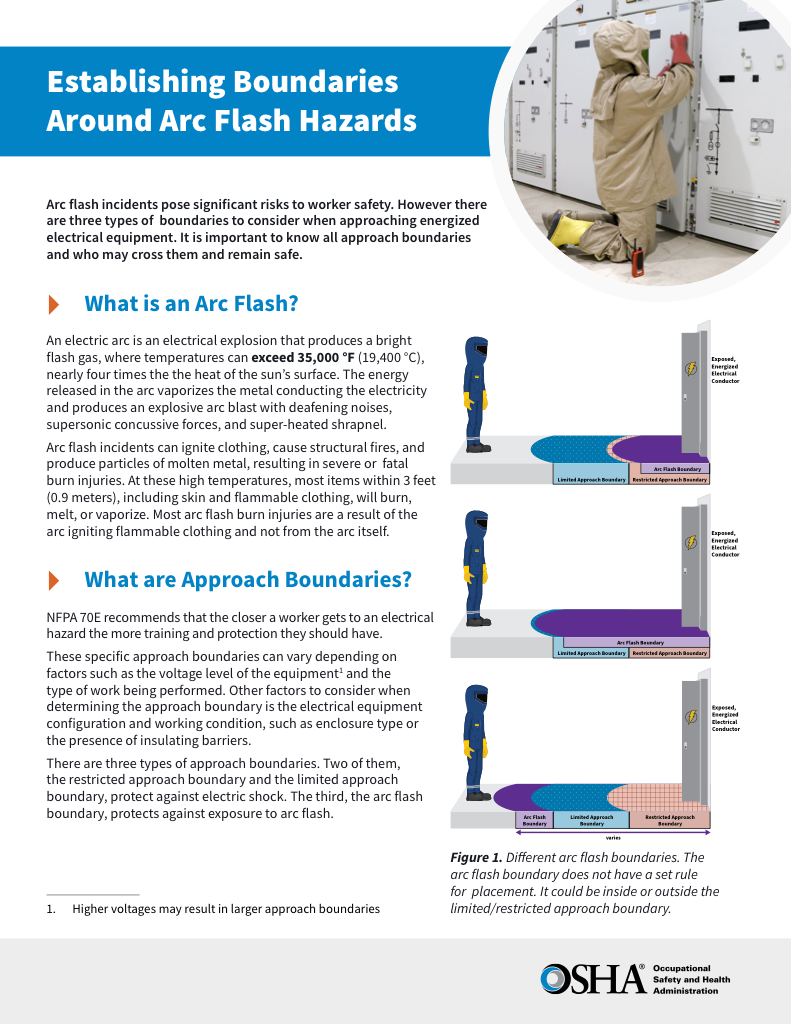
- Understand the difference between arc flash and electric shock boundaries
- Learn who may cross each boundary and under what conditions
- Apply voltage-based rules for safer approach distances
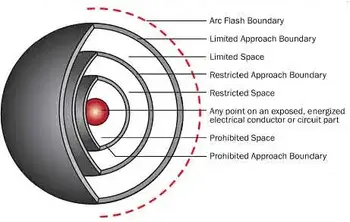
An arc flash boundary chart provides a quick reference of typical boundary distances by incident energy level, helping workers compare exposure risk and maintain safe working distances during job planning and field activities.
This chart is designed for job planning, pre-task briefings, field reference, and training support. It focuses on visual comparison and lookup, not on explaining arc flash theory or replacing system-specific calculations.
This page focuses on visual comparison and lookup. For a full explanation of what an arc flash boundary is, how it is calculated, and how it is applied in energized work decisions, see our main arc flash boundary overview.
How This Chart Is Used
Arc flash boundary charts are commonly used by electrical safety workers and supervisors who need a fast reference to understand how boundary distances change as incident energy increases. In practice, this includes:
-
Pre-task planning discussions before energized work
-
Reviewing boundary distances during job briefings
-
Supporting PPE selection decisions
-
Reinforcing safe positioning and barricading in the field
-
Training reinforcement for qualified electrical workers
The chart helps translate incident energy values into practical distance awareness, especially when time or access does not allow for immediate review of a full arc flash study.
Sample Arc Flash Boundary Chart
The table below shows example boundary distances for common system conditions. These values are illustrative and intended for reference only. The distances shown in an arc flash boundary chart summarize results produced by arc flash analysis, providing a visual reference to outcomes that are calculated elsewhere rather than explained here.
| System Voltage | Available Fault Current (kA) | Clearing Time (s) | Incident Energy (cal/cm²) | Arc Flash Boundary (AFB) |
|---|---|---|---|---|
| 208V | 15 | 0.1 | 1.5 | 18 inches (1.5 ft) |
| 480V | 10 | 0.1 | 2.8 | 36 inches (3 ft) |
| 600V | 25 | 0.2 | 8.0 | 60 inches (5 ft) |
| 480V | 35 | 0.5 | 12.0 | 96 inches (8 ft) |
| 13.8kV | 5 | 0.1 | 4.0 | 48 inches (4 ft) |
These distances are part of a wider compliance framework; to understand how they fit into safety program obligations, consult our electrical safety and electrical safety requirements pages.
FREE EF Electrical Training Catalog
Download our FREE Electrical Training Catalog and explore a full range of expert-led electrical training courses.

- Live online and in-person courses available
- Real-time instruction with Q&A from industry experts
- Flexible scheduling for your convenience
Important Limitations of Boundary Charts
Arc flash boundary charts are reference tools. They do not replace engineering analysis or arc flash studies.
Actual boundary distances must be calculated for each piece of equipment based on real system conditions, including protective device coordination, enclosure configuration, and working distance. Charts show typical trends, not guaranteed safe distances.
Boundary distances used for work authorization, labelling, and PPE selection should always be based on calculated system data, not chart values alone. For calculation-based boundaries, refer to our arc flash boundary page.
Using Charts Alongside Arc Flash Studies
In facilities with completed arc flash studies, charts are often used as supporting references rather than as decision-making authorities. They help workers visualize why some equipment requires larger exclusion zones and heavier PPE than others.
Charts are especially useful during training, audits, and safety program reviews, where the goal is to understand relative risk rather than to approve specific energized tasks.
When Not to Rely on a Chart
A chart should not be used when:
-
Performing energized work authorization
-
Labeling equipment
-
Determining NFPA 70E arc flash requirements for PPE for a specific task
-
Establishing barricades or approach controls
-
Working on modified or newly installed systems
In these situations, calculated incident energy and boundary distances must be used.
Related Pages
