Arc Flash PPE Requirements Chart Explained
By William Conklin, Associate Editor
CSA Z462 Arc Flash Training – Electrical Safety Compliance Course
Our customized live online or in‑person group training can be delivered to your staff at your location.
- Live Online
- 6 hours Instructor-led
- Group Training Available
Download Our OSHA 3875 Fact Sheet – Electrical PPE for Power Industry Workers
- Follow rules for rubber gloves, arc-rated PPE, and inspection procedures
- Learn employer obligations for testing, certification, and training
- Protect workers from arc flash and electrical shock injuries
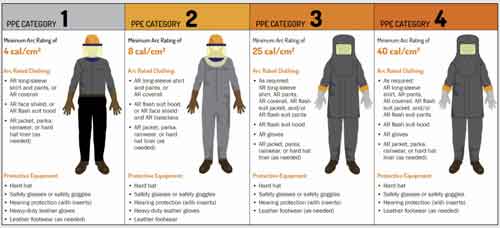
The Arc Flash PPE Requirements Chart translates NFPA 70E incident energy levels into a visual reference for selecting arc-rated clothing and protective equipment. It does not determine compliance on its own, but it shows how PPE categories align with exposure severity, so workers can verify protection choices before energized work.
This chart exists for one purpose: fast, accurate PPE confirmation when time and clarity matter. It is not a substitute for an arc flash study, a risk assessment, or NFPA 70E judgment. It is a reference lens that helps professionals confirm whether their protective ensemble matches the energy hazard in front of them.
How the Arc Flash PPE Requirements Chart Should Be Used
The chart organizes PPE by incident energy (cal/cm²) and aligns each range with the protective ensemble expected under NFPA 70E task guidance. It allows safety leaders, planners, and electricians to quickly confirm whether clothing, face protection, gloves, and body coverage scale correctly with the exposure level.
-
The chart does not assign risk.
-
The chart does not replace analysis.
-
The chart confirms alignment.
That distinction matters. PPE errors almost always come from treating category labels as protection guarantees rather than as exposure-based guidance.
For formal compliance interpretation, the authority reference remains the NFPA 70E PPE requirements page:
NFPA 70E Arc Flash PPE Requirements
Request a Free Training Quotation
Incident Energy and Category Meaning
Each PPE category on the chart corresponds to a defined incident energy range. Those ranges describe how much thermal energy could reach the worker during an arc flash event. The higher the energy, the more complete the protective system must become.
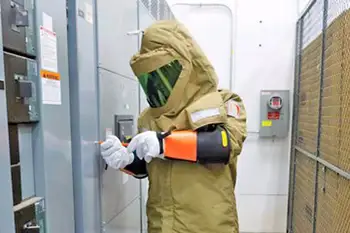
What the chart makes visible is not just the category number, but the escalation of responsibility for protection as energy rises. Face shields become arc-rated hoods. Shirts and pants become full-body systems. Gloves, balaclavas, and layered ensembles move from optional to mandatory.
FREE EF Electrical Training Catalog
Download our FREE Electrical Training Catalog and explore a full range of expert-led electrical training courses.
- Live online and in-person courses available
- Real-time instruction with Q&A from industry experts
- Flexible scheduling for your convenience
Category numbers are not the hazard.
Incident energy is.
This is why PPE selection must always begin with exposure, not with clothing labels.
For category definitions and boundaries, see: Arc Flash PPE Category Guide
Where High-Calorie Suits Enter the Chart
Once the incident energy exceeds the standard clothing limits, the chart transitions into full-suit territory. These ranges are where selection errors pose the greatest injury risk.
Professionals working in this zone should understand both rating limits and system coverage:
40 cal protection systems: 40 Cal Arc Flash Suit
100 cal protection systems: 100 Cal Arc Flash Suit
The chart does not teach how these suits are constructed. It confirms when they are required.
What the Chart Does Not Protect Against
The PPE chart only addresses thermal exposure. It does not account for:
• Blast pressure
• Molten metal projection paths
• Tool trajectory
• Equipment enclosure failure
• Body positioning
This is why PPE selection must always be paired with work practice controls, approach boundaries, and job planning. Clothing does not make hazardous work safe. It only limits injury when other controls fail.
Why This Chart Exists as a Separate Page
This page is intentionally limited to chart interpretation and reference use. It does not repeat requirements narrative, compliance rules, or PPE theory.
For applied interpretation and field judgment, see: Arc Flash PPE Requirements
For compliance authority, see the NFPA page linked above.
This separation protects ranking clarity and prevents intent dilution.
Using the Chart Responsibly
-
Use the chart to confirm.
-
Use studies to decide.
-
Use standards to govern.
When all three agree, PPE selection becomes defensible.
When any one is used alone, PPE selection becomes a guess.
The Arc Flash PPE Requirements Chart is not about convenience. It is about alignment. It exists to reduce the distance between incident energy reality and clothing decisions so that workers are not protected by assumption.
Its value is speed, clarity, and visual confirmation, not authority.
Related Articles
