Voltage Drop Formula
By John Houdek, Power Quality Editor
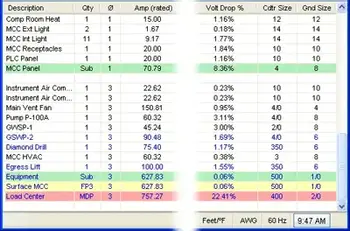
Voltage drop formula calculates the reduction in voltage that occurs along a conductor as current flows through it. The loss depends on current, conductor resistance, and circuit length, and directly affects equipment performance, efficiency, and compliance with recommended voltage limits.
In real installations, voltage drop is not a theoretical inconvenience. Excessive drop reduces usable voltage at the load, increases conductor heat, shortens equipment life, and limits the capacity a circuit can safely deliver. The voltage drop formula allows designers and electricians to predict these effects before a circuit is installed, so conductor size, run length, and load can be balanced rather than guessed.
Although the relationship is mathematically simple, its consequences are not. Small increases in current or distance can produce losses that are invisible on drawings but costly in operation. Understanding how the voltage drop formula works is therefore essential for designing circuits that remain efficient, stable, and serviceable under real operating conditions.
Voltage Drop Formula Fundamentals
The fundamental voltage drop relationship is expressed as:
V = I × R
In this expression, V represents the voltage lost along the conductor, I is the current in amperes, and R is the total resistance of the conductor over the circuit length. This relationship shows that voltage loss is not caused by a single factor but by the combined effects of load, distance, and conductor characteristics.
In practical electrical design, resistance is not treated as a fixed value. It depends on the conductor material, cross-section, temperature, and total circuit length. For that reason, conductor size is commonly evaluated in circular mils, and voltage drop limits are applied to ensure circuits deliver usable voltage without excessive loss or thermal stress. The formula provides the quantitative foundation for those design judgments.
Because voltage drop affects both performance and safety margins, professionals rely on the formula to validate conductor selection, confirm installation quality, and prevent hidden energy loss that would otherwise only appear after a system is energized. When calculations are required for specific conductor sizes and circuit lengths, a voltage drop calculator provides a faster way to verify results and compare design options.
You can learn more about how electrical resistance affects circuits in our detailed voltage drop guide, which explains causes, calculations, and solutions for safe, efficient power distribution.
Power Quality Analysis Training
Request a Free Power Quality Training Quotation
DC and Single-Phase Voltage Drop
For DC circuits and single-phase AC, the voltage drop is computed by including the full round-trip length of the conductor:
Vdrop = I × (2 × L × Rwire / 1000)
Here, L is the one-way length of the wire, and Rwire is the conductor resistance per 1000 feet or meters, depending on the measurement system. This formula helps determine the impact of distance and conductor choice on circuit performance.
Three-Phase Voltage Drop
Three-phase systems use a similar approach, but the geometry of three-phase power introduces a √3 factor:
Vdrop = √3 × I × (L × Rwire / 1000)
This version is widely used for industrial feeders, distribution circuits, and larger commercial installations.
Wire Diameter and Cross-Section Calculations
Wire gauge also influences voltage drop, and engineers sometimes calculate the physical properties of conductors to refine their analysis. The American Wire Gauge (AWG) system relates wire size to diameter and area. Larger cross-sectional areas carry more current with less resistance, reducing voltage drop across long distances.
Wire diameter formulas:
dn (inches) = 0.005 in × 92(36–n)/39
dn (mm) = 0.127 mm × 92(36–n)/39
Wire cross-sectional area:
An (kcmil) = 1000 × dn²
An (in²) = (π / 4) × dn²
An (mm²) = (π / 4) × dn²
Wire resistance calculations
Resistance depends on the material’s resistivity and the conductor’s cross-sectional area. These calculations help determine how much voltage drop to expect under load:
Rn (Ω/kft) = 0.3048 × 10? × ρ / (25.42 × An(in²))
Rn (Ω/km) = 10? × ρ / An(mm²)
By combining wire resistance with circuit length and load current, installers can predict performance and prevent issues such as overheating, dim lighting, reduced motor torque, and wasted energy.
Applications and Practical Use
Voltage drop analysis is essential for branch circuits, feeders, solar installations, EV chargers, long-distance lighting runs, and any application where the conductor length is significant. Calculating voltage drop early in the design process helps avoid costly rework and ensures the system delivers the required voltage to each device.
Related Pages
_1497173102.webp)
_1497153600.webp)