Solar Power Invertors
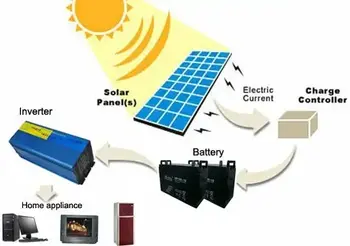
Solar power inverters convert DC to AC for PV systems, using MPPT to optimize yield; supports grid-tie, off-grid, battery storage, string and microinverters with high efficiency, monitoring, and safety features.
How Solar Power Inverters Work
Solar power inverters are an indispensable component of virtually all electric‑generating renewable energy systems. Inverters come in three basic types: those designed for grid‑connected systems, those made for off‑grid systems, and those designed for grid‑connected systems with battery backup. For broader context on system types and design goals, the overview of renewable energy systems highlights how inverters fit within complete installations across different technologies.
Grid‑Connected Inverters
Today, the vast majority of renewable energy systems ‑ both solar and wind electric ‑ are grid‑connected. These systems require inverters that operate in sync with the utility grid. They produce electricity that is identical to that available on the grid. This type of electricity is known as grid‑compatible sine wave AC electricity.
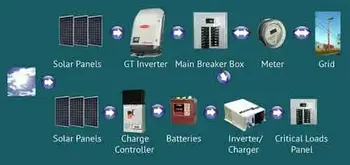
Grid‑connected solar power inverters are also known as utility‑tie inverters. They convert DC electricity from the array in a PV system into AC electricity. Electricity then flows from the inverter to the breaker box and is then fed into active circuits, powering refrigerators, computers, and the like. Surplus electricity is then back‑fed onto the grid, running the electrical meter backward. For a step by step view of components and power flow, see how a solar PV system interfaces with inverters, panels, meters, and household loads.
Grid‑tied inverters produce electricity that matches the grid both in frequency and voltage. To do this, these inverters monitor the voltage and frequency of the electricity on the utility lines. They then adjust their output so that it matches that available on the grid. That way, electricity that is fed from a PV system onto utility lines is identical to the electricity utilities are transmitting to their customers.
Grid‑compatible inverters are equipped with anti‑islanding protection ‑ a feature that automatically disconnects the inverter from the grid in case of loss of grid power. That is, grid‑connected inverters are programmed to shut down if the grid goes down. The inverter stays off until ‑service is restored. This feature protects utility workers from electrical shock.
Grid‑compatible inverters also shut down if there's an increase or decrease in either the frequency or voltage of grid power outside the inverter's acceptable limits (established by the utility companies). If either varies from the inverter's pre‑programmed settings, the inverter turns off.
The inverter shuts down entirely in the case of blackouts, because it requires grid connection to determine the frequency and voltage of the AC electricity it produces. Without the connection, the inverter can't operate.
Grid‑connected inverters also come with a fault condition reset ‑ a sensor and a switch that turns the inverter on when the grid is back up or the inverter senses the proper voltage and/or frequency.
To avoid losing power when the grid goes down, a homeowner can install a grid‑connected system with battery backup. Although inverters in such systems disconnect from the utility during outages, they can draw electricity from the battery bank to supply active circuits. As noted in the previous chapters, such systems are typically designed and wired to provide electricity only to essential circuits in a home or business, supplying the most important (critical) loads.
Grid‑connected inverters also frequently contain LCD displays that provide information on the input voltage (the voltage of the electricity from the PV array) and the output voltage (the voltage of the AC electricity the inverter produces and delivers to a home and the grid). They also display the current (amps) of the AC output.
Some inverters, like the Trace SW utility‑intertie series inverters, come with automatic morning wake‑up and evening shutdown. These features shut the inverter down at night (as it is no longer needed) and wake it up in the morning (to get ready to start converting DC electricity from the array into AC electricity.) This sleep mode in the SW series inverters uses less than 1 watt of power.
Grid‑connected inverters operate with a fairly wide input range. The DC operating range of the SW series, for instance, ranges from 34 to 75 volts DC (you might see this listed as "VDC"). Inverters from Fronius and Oregon‑based PV Powered Design are designed to operate within a broader DC voltage input range: from 150 to 500 volts DC. This permits the use of a wider range of modules and system configurations. Moreover, high‑voltage arrays can be placed farther from the inverter than low‑voltage arrays. In addition, high‑voltage DC input means that smaller and less expensive wires can be used to transmit electricity to a home or office from the array. With the cost of copper skyrocketing as a result of higher energy prices and higher demand, savings on wire size can be substantial. To evaluate the financial impact of these wiring and voltage choices, an introduction to solar power economics explains typical cost drivers, payback periods, and sensitivity to material prices.
Off‑Grid Inverters
Like grid‑connected inverters, off‑grid inverters convert DC electricity into AC and boost the voltage to 120 or 240 volts. Off‑grid inverters also perform a number of other essential functions, discussed here. If you're installing an off‑grid system, be sure to read this section carefully.
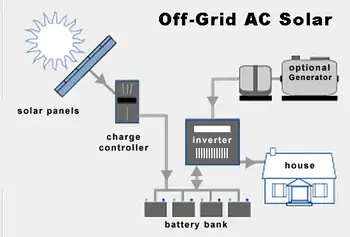
If you are new to remote designs, this practical guide to off grid solar power systems outlines configurations, sizing steps, and common reliability practices.
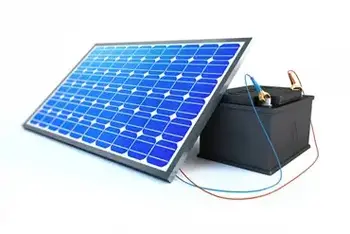
Battery‑based inverters used in off‑grid and grid‑connected systems with battery backup typically contain battery chargers. Battery chargers charge batteries from an external source ‑ usually a genset in an off‑grid system. But isn't the battery charged by the PV array through the charge controller ?
The charge controller in battery‑based systems does indeed charge batteries, however, its job is to charge batteries from the PV array, not a gen‑set. The charge controller therefore receives DC electricity from a wind turbine PV array, then sends it to the battery bank. The charge controller also prevents batteries from being overcharged. A battery charger in the inverter, on the other hand, converts AC from a gen‑set and converts it to DC. It then feeds DC electricity to the batteries. For deeper background on settings and features, see how a solar power controller manages charging stages, safety limits, and integration with inverters.
In off‑grid systems, battery charging gen‑sets are used to restore battery charge after periods of deep discharge. This prolongs battery life and prevents irreparable damage to the plates. Battery chargers are also used during equalization. In some cabins and mobile applications, portable solar power generators can supplement gen sets to reduce fuel use and noise during moderate loads.
High‑quality battery‑based inverters also contain programmable high‑ and low‑voltage disconnects. These protect various components of the system, such as the batteries, appliances, and electronics in a home or business. They also protect the inverters.
The high‑voltage disconnect is a sensor/switch that terminates the flow of electricity from the gen‑set when the batteries are charg‑ing if the battery voltage is extremely high. (Remember: high battery voltages indicate that the batteries are full.) High‑voltage protection therefore prevents overcharging, which can severely damage the lead plates in batteries. It also protects the inverter from excessive battery voltage. The low‑voltage disconnect (LVD) in an inverter monitors battery voltage at all times. When low battery voltage is detected (indicating the batteries are deeply discharged) the inverter shuts off and often sounds an alarm. The flow of electricity from the batteries to the inverter stops. The inverter stays off until the batteries are recharged.
Low‑voltage disconnect features are designed to protect batteries from very deep discharging. Although lead‑add batteries are designed to withstand deep discharges, discharging batteries beyond the 80% mark causes irreparable damage to the lead plates in batteries and leads to their early demise. Although complete system shutdown can be a nuisance, it is vital to the survival of a battery bank.
Batteries can be recharged by a supplementary wind turbine or by a gen‑set. Gen‑sets may be manually started, although some inverters contain a sensor and switch that activates the generator automatically when low battery voltage is detected. The fossil fuel generator then recharges the batteries using the inverter's battery charger.

Multifunction Inverters
Grid‑connected systems with battery backup require multifunction inverters ‑ battery‑ and grid‑compatible sine wave inverters. They're commonly referred to as multifunction or, less commonly, multimode inverters.
Multifunction inverters contain features of grid‑connected and off‑grid inverters. Like a grid‑connected inverter, they contain antiislanding protection that automatically disconnects the inverter from the grid in case of loss of grid power, over/under voltage, or over/under frequency. They also contain a fault condition reset to power up an inverter when a problem with the utility grid is corrected. Like off‑grid inverters, multifunction inverters contain battery chargers and high‑ and low‑voltage disconnects.
If you are installing an off‑grid system, you may want to consider installing a multifunction inverter in case you decide to connect to the grid in the future. However, even though multifunction inverters allow system flexibility, they are not always the most efficient inverters. That's because some portion of the electricity generated in such a system must be used to keep the batteries topped off. This may only require a few percent, but over time a few percent add up. In systems with poorly designed inverters or large backup battery banks, the electricity required to maintain the batteries can be quite substantial. It is also worth noting that as batteries age, they become less efficient; more power is consumed just to maintain the float charge, that is, a constant "resting" voltage. This reduces the efficiency of the entire PV system.
For best results, I recommend inverters that prioritize the delivery of surplus electricity to the grid while preventing deep discharge of the battery bank, such as OutBack's multifunction inverters and Xantrex's XW series inverters.
If you want the security of battery backup in a grid‑connected system, I suggest that you isolate and power only critical loads from the battery bank. This minimizes the size of your battery bank, reduces system losses, and reduces costs. Unless you suffer frequent or sustained utility outages, a batteryless grid‑connected system usually makes more sense from both an economic and environmental perspective. When comparing backup versus batteryless designs, a balanced review of solar power pros and cons can clarify environmental impacts, reliability needs, and budget constraints.