Control Switches for Arc Flash
By Bryan Johnson, P.Eng.
CSA Z462 Arc Flash Training – Electrical Safety Compliance Course
Our customized live online or in‑person group training can be delivered to your staff at your location.
- Live Online
- 6 hours Instructor-led
- Group Training Available
Download Our OSHA 4475 Fact Sheet – Being Aware of Arc Flash Hazards
- Identify root causes of arc flash incidents and contributing conditions
- Apply prevention strategies including LOTO, PPE, and testing protocols
- Understand OSHA requirements for training and equipment maintenance
Control switches for arc flash and blast protection optimize electrical safety by enabling remote racking, arc-resistant switchgear operation, incident energy mitigation, and reduced PPE requirements for operators under NFPA 70E and lockout tagout procedures.
Principles of Control Switches for Arc Flash and Blast Protection
It may seem like a long time ago, but in terms of the age of the earth, electricity is in its infancy. When famous names such as Franklin, Edison, Tesla, and Volta were mesmerized by that “blue flame,” who could have imagined the unlimited potential (no pun intended)? Electricity is part of everyone’s life, and living without it is practically impossible.
The biggest task after the discovery of electricity was developing a way to generate and harness such a wild beast. Today, we walk into a room, turn on a light, an appliance, a fan, or any number of devices, but never really think about exactly how the power got to its destination.
Since usable electricity does not exist naturally, it must be generated. Almost all commercial electricity is produced by a turbine driven by wind, water, or steam, which rotates a magnet inside a coil of wire, commonly called a generator. A group of generators or power plant can then be used to send electricity via transmission lines at very high voltages to power substations where transformers reduce the voltages down to voltage that is suitable for consumer use and distribution.
Once the power is in a usable state, it is connected to a series of fuses and circuit breakers commonly referred to as switchgear. Switchgear is used to control, protect, and isolate electrical equipment, and to de-energize the equipment for maintenance or to clear faults downstream from a breaker. Adhering to broad electrical safety practices strengthens these protective measures during switching and maintenance.
FREE EF Electrical Training Catalog
Download our FREE Electrical Training Catalog and explore a full range of expert-led electrical training courses.

- Live online and in-person courses available
- Real-time instruction with Q&A from industry experts
- Flexible scheduling for your convenience
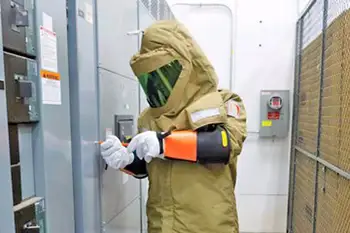
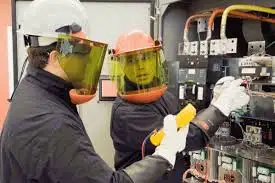
During the turning “ON” of circuit breakers, whether for new installations or after equipment maintenance or repair, there is a possibility of significant fault currents due to wiring errors or conductors being too close to each other or to ground. This is a condition known as “arc flash and blast”. Arc flash is the immediate light produced by the fault. Arc blast is the release of energy from the fault that can be strong enough to throw personnel to the ground and cause equipment damage. Arc blasts can also result in hearing loss and can turn loose equipment, tools, and debris into deadly projectiles. Comprehensive training aligned with the industrial electrical safety guidelines helps teams recognize precursors to these events before work begins.
Industrial Safety and Hygiene News estimated that, on average, there are 30,000 arc-flash incidents each year, resulting in 7,000 burn injuries, 2,000 hospitalizations, and 400 fatalities. OSHA mandates that employers identify electrical hazards, warn employees about them, and provide proper protection and training regarding them. Understanding arc-flash compliance can be complicated. While OSHA tells you “what to do” for arc flash, they don’t tell you “how” to do it. For implementation details, many facilities base procedures on a formal assessment, and our how to perform an arc flash study article outlines the typical steps and data requirements. Avoiding missteps during analysis is critical, and the most common errors in arc flash analysis are worth reviewing before commissioning any study.
How do you close or open an industrial circuit breaker?
Typically, a circuit breaker is a mechanism driven by the mechanical energy stored in springs. The closing spring is mechanically charged by a motor and is held in its compressed position by a closing latch. When a close signal releases this latch, this spring pushes against a mechanical linkage to force the breaker contacts closed and, at the same time, charges the trip spring. The closing spring is then immediately recharged by the motor. Another latch holds the tripping spring in the compressed position until an open signal releases it. Selecting equipment with proven interruption characteristics, such as an arc flash breaker, can reduce incident energy during faults.
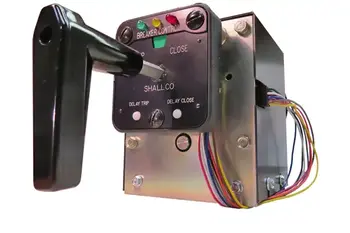
To provide the signal to the tripping and closing latches, a Control Switch is incorporated into the switchgear. Control switches are configured in an infinite number of ways depending on the design of the switchgear and the number of functions required in addition to the “Trip” and “Close” task.
Shallco, Inc. began manufacturing Industrial Control Switches and Protective Lockout relays more than 20 years ago. Shallco offers standard Breaker Control Switches, Selector Switches, Ammeters, and Voltmeter Switches, along with thousands of customer-specified switches to perform any switching task engineers might require.
Remote operation: To enable remote operation of the control switch, a rotary and linear solenoid drive mechanism was integrated into the standard manually operated switch. The result: two types of operation in one package. A standard manual shaft rotation and/or a remote electrical operation.
Now, what is needed to protect the operator from the arc fault and blast described previously?
Answer: Shallco added a microprocessor-controlled signalling board and an LED indicating operation panel that allows the operator to vacate the danger zones for 10 seconds to 2 minutes. The operation is pretty straightforward. There are two operating buttons on the front of the lighted panel.
Delay Trip Operation
Pressing and holding the delay/trip button for 4 seconds or longer will initiate the delay trip operation. The left (green) LED will start flashing and will remain flashing after the button is released. After a few additional seconds, the LED will begin to flash faster. After 10 seconds (up to 2 minutes, depending on the programming), the breaker will trip.
To cancel the operation, press either the delay/trip or delay close button at any time after the operation is initiated.
Electricity Today T&D Magazine Subscribe for FREE

- Timely insights from industry experts
- Practical solutions T&D engineers
- Free access to every issue
Delay Close Operation
Pressing and holding the delay/close button for 4 seconds or greater will initiate the delay close operation. The right (red) LED will start flashing and will remain flashing after the button is released. After a few additional seconds, the LED will begin to flash faster. After 10 seconds (up to 2 minutes depending on the programming), the breaker will close.
To cancel the operation, press either the delay/trip or the delay close button.
The relay also provides connections for user-selectable 52A or 52B contacts. These are part of an independent circuit connection to the LEDs on the front panel and can be used to indicate any condition the user might need. To support compliance and worker awareness, integrated arc flash analysis and labeling solutions can be used to generate equipment-specific warnings.
The center LED is commonly used as a Trip Coil Monitor Circuit with a SCADA output.
For day-to-day operations, clear electrical panel labels help technicians verify boundaries, PPE, and isolation points before starting work.
