Industrial Electrical Safety Explained
By Howard Williams, Associate Editor
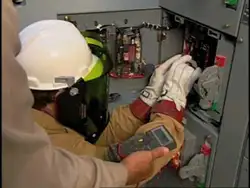
NFPA 70E Training
Our customized live online or in‑person group training can be delivered to your staff at your location.
- Live Online
- 6 hours Instructor-led
- Group Training Available
Download Our OSHA FS3529 Fact Sheet – Lockout/Tagout Safety Procedures
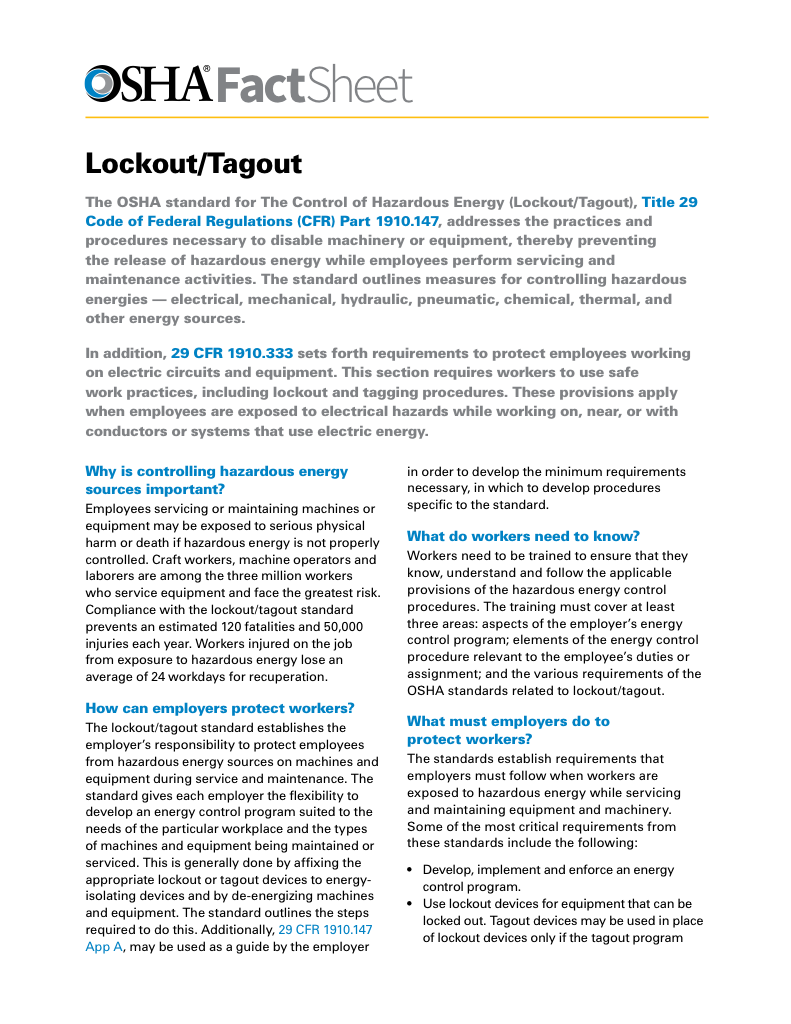
- Learn how to disable machines and isolate energy sources safely
- Follow OSHA guidelines for developing energy control programs
- Protect workers with proper lockout devices and annual inspections
Industrial electrical safety ensures OSHA compliance by implementing lockout/tagout, arc-flash mitigation, NFPA 70E procedures, PPE selection, grounding and bonding, risk assessment, and preventive maintenance to control hazards in factories and process plants.
Industrial Electrical Safety: Real-World Examples
On average, every 30 minutes, a worker is so severely injured on the job that they require time off to recover. Approximately 3 million power professionals use lockout/tagout procedures each day. In industrial environments where multiple standards often overlap, OSHA electrical safety enforcement provides the governing authority that inspectors rely on during investigations.
It is these sheer numbers that contribute to industrial power-related violations ranking among the top 10 OSHA violations. The two that continue to make the top 10 are wiring methods and general requirements.
Request a Free Training Quotation
The National Institute for Occupational Safety and Health (NIOSH) identify four main types of electricity-related injuries:
- electrocution
- electric shock
- burns
- falls
Understanding these categories helps teams tailor procedures you should follow to protect against electrocution to specific tasks.
To prevent or mitigate injury, it is important to ensure employees are properly trained and qualified for their jobs. A few safety tips to remember to help avoid injuries include:
-
Isolate equipment from energy sources
-
Test circuits and conductors every time before coming in contact
-
Identify potential electric shock and arc flash hazards
-
Only work on de-energized equipment and conductors
-
Always lockout/tagout and properly ground equipment before you begin working
-
Treat all equipment as live until lockout/tagout, testing and grounding procedures have been implemented
-
Always wear proper Personal Protective Equipment (PPE) and clothing in areas where potential hazards and arc flash situations are present.
-
Use insulated tools whenever possible.
Embedding these practices into daily routines supports compliant electrical safety work that minimizes exposure to energized parts.
Sign Up for Electricity Forum’s Arc Flash Newsletter
Stay informed with our FREE Arc Flash Newsletter — get the latest news, breakthrough technologies, and expert insights, delivered straight to your inbox.
There are more than 300 electrocutions and some 4,000 injuries in the workplace each year directly related to hazards. Although not the leading cause of workplace injuries, hazards cause serious injury and death and are costly to the employer. Often overlooked, grounding is a major component of electrical safety, as outlined in OSHA 1910.305, subpart S, Wiring Design. Organizations can benchmark programs against electrical safety requirements to close gaps and improve accountability.
Good electrical grounding creates a low-resistance path socharges can flow safely away from the work area, preventing harm. Normally, grounding is built into the power system as a permanent part, but it should never be taken for granted. These principles align with proven electrical safety workplace practices that emphasize verification and maintenance.
Lockout Tagout Procedures
Proper tagout procedures (of electrical boxes and equipment) are a major component of any safety program. “Tagging out” refers to locking circuit breakers or start-up panels and attaching warning tags so that no other worker accidentally throws the switch. Clear labelling and documentation are essential elements within broader electrical safety procedures that prevent inadvertent energization.
In Canada, the Canadian Standards Association established CAN/CSA-Z1000-06, Occupational Health and Safety Management Systems (OHSMS) as the national standard. Sections 4.4.2 and 4.4.3 include the preventive and protective measures and their application. These include:
- elimination of the hazard;
- identifying the nature and extent of the hazards and risks;
- the degree of hazard and risk reduction required; and
- applying recognized standards, codes, and best practices in the industry sector.
Adopting such systems fosters a culture of electrical safety where risk assessments inform training and continuous improvement.