Active Power
By John Houdek, Power Quality Editor
Active power is the usable electrical power that performs real work in AC circuits. Measured in kilowatts, it depends on voltage, current, and power factor, and determines true energy consumption, system efficiency, and accurate electrical billing.
Understanding Active Power
Active power refers to the portion of electrical energy that is actually converted into useful work within a system. This is the energy that lights rooms, turns motors, heats elements, and powers electronic devices. Unlike other forms of power that circulate within the system, active power is consumed by the load and forms the basis for energy billing and efficiency analysis.
In alternating current systems, voltage and current do not always rise and fall together. Only the portion of the current that remains aligned with the voltage contributes to usable energy. Active power represents this productive interaction between voltage and current, while any misalignment introduces inefficiencies elsewhere in the system.
How Active Power Works
In an AC circuit, current can be divided into two components. One component is in phase with the voltage and performs useful work. The other component is out of phase and contributes no net energy to the load. Active power is produced exclusively by the in-phase component, which means it directly reflects how effectively an electrical system delivers real energy to equipment.
Because of this relationship, active power is often described as real power or true power. All three terms refer to the same concept: the energy actually consumed rather than returned to the source.
Active Power Formula
Active power is calculated using the standard relationship:
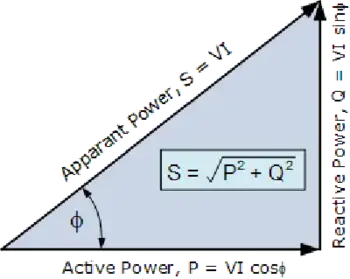
P = V × I × cos θ
In this equation, voltage and current are expressed as RMS values, and the cosine term represents the phase angle between them. When voltage and current are perfectly aligned, the cosine term equals one and all supplied energy becomes active power. As the phase angle increases, the usable portion of that energy decreases.
This formula remains valid under both sinusoidal and mildly distorted conditions. In modern electrical systems, voltage distortion is typically low enough that this calculation provides accurate real-world results.
Equation 1
The above active power equation is valid for both sinusoidal and nonsinusoidal conditions. For sinusoidal condition, '1rn, resolves to the familiar form,
Equation 2
Sinusoidal and Non-Sinusoidal Conditions
Under ideal sinusoidal conditions, active power is determined solely by the fundamental frequency of the waveform. In systems with harmonic distortion, additional frequency components contribute small amounts of real power. Since most power systems maintain voltage distortion below five percent, these harmonic contributions rarely affect overall active power calculations in a meaningful way.
Practical Example of Active Power
An incandescent lamp offers a simple illustration. When connected to a supply, voltage and current remain largely in phase, and nearly all electrical energy is converted into light and heat. In this case, most of the supplied power is active power, with minimal losses due to phase shift.
Active vs Reactive vs Apparent Power
Electrical power is often divided into three related quantities. Active power represents real energy consumption. Reactive power represents energy that oscillates between the source and reactive elements, such as inductors and capacitors. Apparent power combines both and defines the total electrical demand placed on the system.
Although only active power performs work, apparent power affects equipment sizing, and reactive power influences voltage stability. Their interaction is reflected in the power factor, a key indicator of system efficiency.
In an electric circuit, especially in DC circuits or AC systems feeding inductive equipment, understanding the relationship between active and reactive power is essential. The power supplied by the source and the load is divided into usable energy and stored energy, which together make up the total power, expressed in volt-amperes.
Inductive load conditions, such as those created by induction motors, draw volt-ampere reactive in addition to real power, meaning the source must deliver higher volt-amperes to satisfy magnetic field requirements, even though only part of that energy performs useful work.
Measurement and Engineering Use
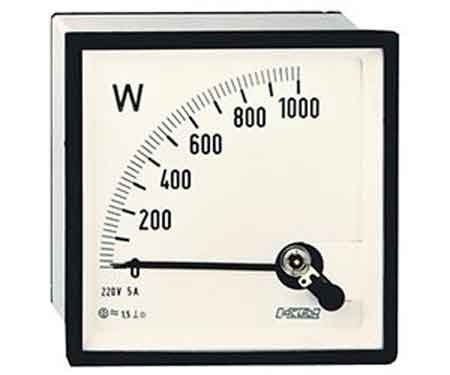
Active power is measured using true-RMS instruments that compute the average product of the instantaneous voltage and current. Modern power analyzers can accurately capture real power even in systems with waveform distortion.
Engineers rely on active power data for energy audits, system optimization, demand forecasting, and compliance with efficiency standards. A clear understanding of active power allows better control of operating costs and improved system performance.
Related Articles
-
Understand the difference between active and reactive power
-
Learn how to improve system performance with our power quality analysis training
-
Discover how electrical resistance affects power consumption
-
Explore the role of power factor correction in reducing energy waste
_1497173102.webp)