What is Transient Voltage?
By Frank Baker, Associate Editor
Grounding and Bonding and The NEC - Section 250
Our customized live online or in‑person group training can be delivered to your staff at your location.
- Live Online
- 12 hours Instructor-led
- Group Training Available
Download Our OSHA 4474 Fact Sheet – Establishing Boundaries Around Arc Flash Hazards
- Understand the difference between arc flash and electric shock boundaries
- Learn who may cross each boundary and under what conditions
- Apply voltage-based rules for safer approach distances
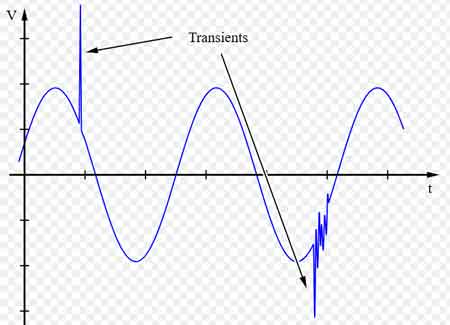
Transient voltage is a short, high-frequency spike in electrical systems caused by lightning, switching, or inductive loads. It affects power quality, stresses equipment, and requires surge protection to maintain system reliability.
Understanding Transient Voltage
Transient voltage refers to brief, abrupt departures from normal system voltage, often appearing and disappearing before anyone knows they occurred. These spikes originate from familiar events, such as lightning strikes, switching actions in distribution equipment, or the release of stored energy in inductive components. For engineers and maintenance teams, understanding these disturbances is essential because even short-lived spikes can wear down sensitive equipment, interrupt operations, and compromise overall system reliability. Left unmanaged, transients slowly erode power quality and raise the likelihood of unexpected failures. A strong understanding of transient disturbances starts with recognizing how they affect overall system performance, which is explained in detail on our page about what is power quality.
Causes of Transient Voltage
Lightning is one of the most dramatic and easily recognized causes. Even a strike that lands some distance from a facility can induce a surge that travels through overhead lines or buried conductors. This energy does not behave politely; it moves quickly and unpredictably, and it can enter a system through multiple pathways. Surge protection serves as the first line of defence, diverting that energy before it reaches equipment.
Switching activity within a system also produces transient events. Any time a motor, transformer, or large inductive load is switched on or off, the abrupt change in current can generate a spike. The more complex and heavily loaded the facility, the more switching interactions occur throughout the day. Circuit breakers and switching devices manage current flow but cannot entirely eliminate the spikes that form during rapid transitions. Because many transient events originate from inductive or capacitive behavior during switching, it is useful to review how load characteristics influence system response in our article on capacitive load.
Test Your Knowledge About Power Quality!
Think you know Power Quality? Take our quick, interactive quiz and test your knowledge in minutes.
- Instantly see your results and score
- Identify strengths and areas for improvement
- Challenge yourself on real-world electrical topics
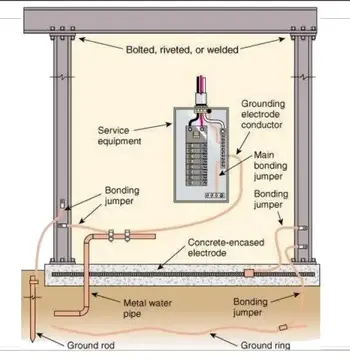
Electrostatic discharge is another contributor, though it often goes unnoticed. When two objects with different electrical charges touch or approach one another, the imbalance equalizes almost instantly, producing a sharp, concentrated spike. In environments such as semiconductor plants, laboratories, or data centers, even a small ESD pulse can disrupt delicate components or corrupt stored data. Grounding, bonding, and anti-static procedures act as essential controls in these settings. Since grounding quality determines how effectively excess energy is diverted during a surge, engineers should examine the fundamentals outlined in our resource on what is electrical grounding.
Types of Transient Voltage: Impulsive vs Oscillatory
Transient events generally fall into one of two categories. Impulsive transients are sharp, unidirectional spikes, either positive or negative, that rise and fall in microseconds. Lightning, utility faults, and electrostatic discharge typically produce this waveform. Although these spikes are short, their amplitude can be large enough to damage equipment immediately. Facilities that experience voltage spikes from lightning activity can also benefit from surge-risk assessment methods described in our guide to lightning protection.
Oscillatory transients behave differently. Instead of a single sharp rise, the voltage oscillates rapidly above and below the normal level in a damped oscillation. These disturbances often originate inside a facility when capacitor banks are energized or de-energized, transformers are switched, or motors start and stop. While the peaks are usually lower than those of impulsive events, the repetitive, high-frequency nature of oscillatory transients can erode insulation, interfere with control systems, and disrupt normal operation over time.
How Surge Protection Devices Work
Surge protection devices detect excessive voltage and safely divert that energy away from equipment. They rely on components engineered to react almost instantly when voltage rises beyond acceptable levels.
Metal Oxide Varistors are the most widely used technology. Under normal operating conditions, an MOV behaves like an open circuit. When the voltage spikes, it becomes conductive, clamping the surge and diverting it toward ground. MOVs provide fast response and good energy-handling capability at a modest cost.
Transient Voltage Suppression diodes work even faster. Their reaction time is measured in picoseconds, making them ideal for protecting sensitive electronics, communication devices, or microprocessor-based controls. Other technologies, such as gas-discharge tubes and silicon avalanche diodes, are used in layered protection schemes that require both high-energy handling and fast response.
Choosing the right protection strategy depends on the system size, the types of transients expected, and the equipment's sensitivity. A well-designed installation often uses multiple protective devices at different points to ensure thorough coverage. For facilities seeking a deeper look at surge handling and mitigation strategies, our detailed explanation of surge suppression offers guidance on selecting appropriate protective technologies.
Effects of Transient Voltage
The impact of transient voltage on equipment can range from subtle to catastrophic. A single high-energy spike may instantly destroy a component, but more often, damage accumulates slowly. Insulation materials weaken, semiconductor junctions degrade, and electronic circuits become less stable over time. These trends shorten equipment lifespans and increase the likelihood of sudden, unexplained failures.
Operationally, transient-related degradation can cause intermittent shutdowns, data loss, control-system errors, and power supply disruptions. For facilities that depend on continuous production or precise monitoring, these effects translate into real financial risk.
Protection Against Transient Voltage
Mitigating transient voltage requires a coordinated approach. Surge protection devices form the core of most protection schemes, but grounding, bonding, and insulation coordination are equally important. Industrial facilities with large distribution systems often install SPDs at service entrances, panelboards, and critical equipment nodes. Voltage stabilizers and power-conditioning equipment may supplement these measures when loads are highly sensitive or when the utility supply is unstable.
Electricity Today T&D Magazine Subscribe for FREE

- Timely insights from industry experts
- Practical solutions T&D engineers
- Free access to every issue
Proper device selection depends on the anticipated surge energy, the facility’s grounding system, and the vulnerability of connected components. When these elements are aligned, the likelihood of transient damage drops sharply.
Measurement and Monitoring of Transient Voltage
Transient events happen quickly, so specialized monitoring is required to capture them. Instruments such as oscilloscopes, high-frequency analyzers, and transient recorders provide insight into when spikes occur, how large they are, and what patterns emerge over time. Modern power systems increasingly incorporate continuous monitoring, allowing technicians to identify recurring problems, trace disturbances back to their source, and make informed decisions about upgrades or protective measures. Accurate evaluation of system disturbances relies on proper diagnostic tools, which are discussed in our overview of the power quality analyzer.
Standards and Regulations for Transient Voltage
International standards guide how equipment should handle transient voltages and on what levels are acceptable. Organizations such as IEEE and IEC publish requirements that manufacturers follow when designing electrical and electronic products. These standards help ensure that equipment can tolerate real-world disturbances and continue operating safely. Compliance also protects end users by ensuring that systems built in different regions or by different manufacturers behave consistently when exposed to transient events.
Frequently Asked Questions
What is the difference between surge and transient voltage (V)?
Surges last longer and carry more energy. They often occur during events such as lightning strikes or the switching of large loads and can last from milliseconds to several seconds. Transient voltage is shorter and more localized. It appears as a quick spike, typically caused by internal switching or inductive load changes. Both require proper protection because their effects accumulate over time.
What causes transient overvoltage?
Transient overvoltage can appear whenever the energy stored in an electrical circuit is suddenly released. Inductive components such as motors and transformers are common sources because their magnetic fields collapse when the current stops flowing. Capacitor switching, lightning, ESD, and utility disturbances also create transient conditions. The shape and intensity of the spike depend on the circuit and the nature of the event.
What is the purpose of a transient voltage suppressor?
A transient voltage suppressor protects connected equipment by clamping excess voltage to a safe level. When a spike occurs, the suppressor becomes conductive, diverting energy away from sensitive components. These devices are widely used in power supplies, communication circuits, and electronic assemblies where stable operation is essential.
Transient voltage is an unavoidable part of electrical systems, yet it can be managed with the right design and protective strategies. Understanding how these spikes occur, how they behave, and how to measure them helps engineers maintain high power quality and prolong the life of their equipment. When transient activity is identified and controlled, facilities benefit from fewer failures, reduced maintenance costs, and more reliable operation.
Related Articles
