Fuse Types Explained
By Harold WIlliams, Associate Editor
Protective Relay Training - Basic
Our customized live online or in‑person group training can be delivered to your staff at your location.
- Live Online
- 12 hours Instructor-led
- Group Training Available
Download Our OSHA 4475 Fact Sheet – Being Aware of Arc Flash Hazards
- Identify root causes of arc flash incidents and contributing conditions
- Apply prevention strategies including LOTO, PPE, and testing protocols
- Understand OSHA requirements for training and equipment maintenance
Fuse types include blade, cartridge, glass, ceramic, resettable PTC, HRC, and high-voltage designs. Each type is defined by its operating speed, voltage and current ratings, AC or DC compatibility, interrupting capacity, and compliance with standards such as IEC, UL, and DIN to ensure safe circuit protection.
Basics of Fuse Types in Electrical Engineering
Fuses play a fundamental role in electrical protection by preventing excessive current from damaging conductors, equipment, and connected loads. When current exceeds a safe level, the fuse element melts and opens the circuit, stopping the fault before it escalates into overheating, insulation failure, or fire. Understanding how different fuse types operate allows engineers and technicians to select protection that matches system voltage, fault energy, and operating conditions. For a concise overview of what a fuse does and how it behaves under fault conditions, see this guide to what a fuse is for foundational context.
There are many fuse types in use today, each designed for a specific purpose. Common categories include AC and DC fuses, automotive and blade fuses, cartridge fuses, high-rupturing-capacity designs, and high-voltage fuses. Specialized designs, such as time-delay and semiconductor fuses, address applications where short inrush currents or sensitive electronics must be protected without nuisance operation. All of these fall within the broader family of circuit protection devices used to safeguard electrical systems. These categories sit within the broader family of circuit protection devices that safeguard conductors and loads.
AC and DC
AC and DC fuses are distinguished primarily by how they interrupt current and extinguish arcs. In alternating current systems, the current naturally passes through zero, which helps quench the arc when the fuse opens. Direct current systems do not have this zero crossing, so DC fuses require more robust construction to interrupt current safely. The voltage rating is critical, as a fuse must withstand the system voltage without restriking once it has operated. Proper selection supports effective overcurrent coordination and safe fault clearing. Understanding these distinctions supports proper coordination of overcurrent protection across systems.
FREE EF Electrical Training Catalog
Download our FREE Electrical Training Catalog and explore a full range of expert-led electrical training courses.

- Live online and in-person courses available
- Real-time instruction with Q&A from industry experts
- Flexible scheduling for your convenience
Automotive
Automotive fuses are designed for low-voltage DC systems commonly found in vehicles and mobile equipment. They are compact, easy to replace, and colour-coded by current rating. Blade fuses are the most widely used automotive style, featuring flat metal blades that plug into fuse blocks. Their design allows quick identification and replacement during maintenance. In automotive panels and other low-voltage applications, blade fuses are often compared with small molded case circuit breakers when serviceability is a concern. In automotive and low-voltage panels, it can be helpful to compare options alongside different circuit breaker types to choose serviceable solutions.
Cartridge and Glass Fuses
Cartridge fuses are cylindrical and enclosed in glass or ceramic tubes. Glass fuses allow visual inspection of the fuse element, making it easy to determine whether the fuse has operated. Ceramic cartridge fuses are stronger and better suited for higher fault currents and elevated temperatures. Inside the cartridge, the fuse element melts when excessive current flows, separating the circuit and limiting damage. Cartridge fuses are common in control panels, power supplies, and industrial equipment.
High Rupturing Capacity Fuses
High-rupturing-capacity (HRC) fuses are designed to interrupt very high fault currents safely. They use a ceramic body filled with arc-quenching material that absorbs energy when the fuse operates. These fuses are commonly applied in power distribution equipment, motor control centers, and transformer protection. Because they limit let-through energy, current-limiting fuse designs are often specified where equipment damage must be minimized during severe short circuits. Where high fault energy must be limited quickly, engineers often specify a current-limiting fuse to reduce let-through energy.

High Voltage Fuses
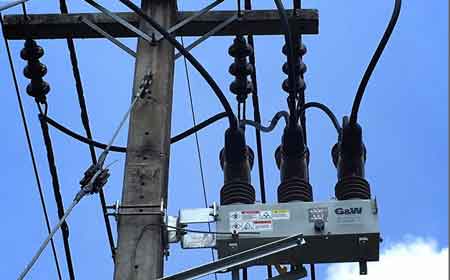
High-voltage fuses are used in systems operating above 1,000 volts, including utility and industrial distribution networks. They protect transformers, capacitors, and feeders from overcurrent and fault conditions. In overhead distribution systems, transformer cutout fuses provide both protection and a visible means of isolation. These fuses must be carefully coordinated with upstream and downstream protection devices to ensure selective operation. Distribution networks that protect overhead transformers may use a transformer cutout fuse for coordinated isolation.
Time-Delay Fuse Types
Type S and Type T fuses are examples of time-delay designs. They are intended to tolerate short-duration inrush currents without opening, making them suitable for circuits supplying motors, transformers, and inductive loads. Type S fuses are commonly used in residential services, while Type T fuses are more frequently applied in industrial environments where higher currents and repeated inrush events occur.
Semiconductor Fuse Types
Type D and Type P fuses, also known as semiconductor fuses, are engineered to protect sensitive electronic components. They operate very quickly and limit fault energy to prevent damage to power electronics such as rectifiers, inverters, and solid-state devices. Their fast response and low let-through energy make them essential in modern electronic and industrial control systems.
Selecting the Right Fuse Type
Choosing the correct fuse involves more than matching the current rating. Voltage rating, interrupting capacity, operating speed, and system type must all be considered. Differences between cartridge, glass, ceramic, and rewirable designs affect durability, inspection, and replacement practices. Proper selection also requires understanding how fuse operation coordinates with other protection devices and how it performs under worst-case short-circuit conditions.
Sign Up for Electricity Forum’s Electrical Protection Newsletter
Stay informed with our FREE Electrical Protection Newsletter — get the latest news, breakthrough technologies, and expert insights, delivered straight to your inbox.
Fuse types remain essential components in electrical systems of all sizes. By understanding their characteristics, applications, and limitations, designers and technicians can select protection that improves safety, reliability, and system performance. Effective electrical planning always considers both overcurrent and short-circuit protection to ensure equipment operates safely under normal and fault conditions.
Comprehensive planning should also address short-circuit protection so that devices operate safely under worst-case faults.
Related Articles
