Electrical Safety Products
CSA Z462 Arc Flash Training – Electrical Safety Compliance Course
Our customized live online or in‑person group training can be delivered to your staff at your location.

- Live Online
- 6 hours Instructor-led
- Group Training Available
Download Our OSHA FS3529 Fact Sheet – Lockout/Tagout Safety Procedures
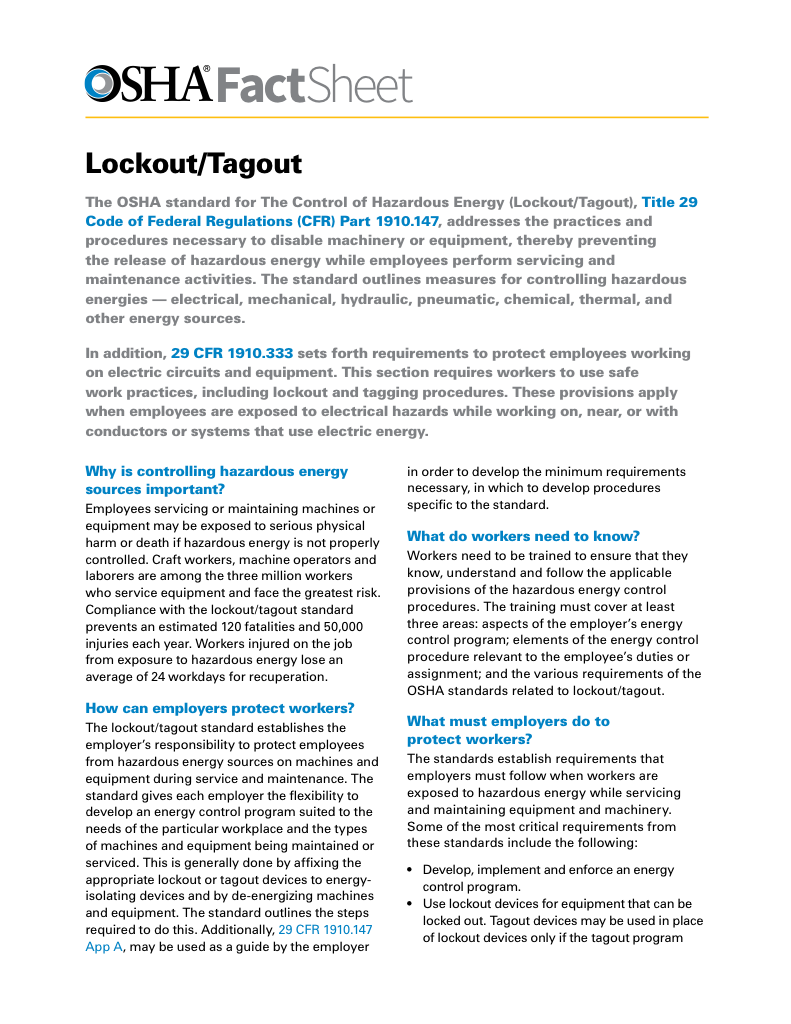
- Learn how to disable machines and isolate energy sources safely
- Follow OSHA guidelines for developing energy control programs
- Protect workers with proper lockout devices and annual inspections
Electrical safety products for engineers include PPE, insulated tools, arc-flash suits, lockout/tagout devices, voltage detectors, RCD/GFCI protection, grounding kits, and surge protectors, all compliant with NFPA 70E and OSHA standards and testing equipment.
Electrical Safety Products and Their Impact on Workplace Safety
Provincial legislation was proposed in Ontario to control the rising number of counterfeit, unapproved, and unsafe electrical products being introduced into the provincial marketplace. For a primer on best practices, refer to this overview of electrical safety fundamentals to see how product compliance ties into hazard prevention.
Electrical Safety Products – Product Registry
Ontario’s electrical sheriff, the Electrical Safety Authority (ESA) introduced a program where product manufacturers must register products being sold or intend on being sold in the province. This program, of course, helps track electrical products and, if any action is necessary against violators, it is deemed necessary. Through this program, ESA also planned to further its preventive and enforcement activities by holding manufacturers and distributors accountable for the sale of unapproved electrical products in the province. The latter reason gives law-abiding manufacturers a fair opportunity to sell their electrical products. For clarity on program oversight and mandate, review the Electrical Safety Authority's guidance to understand registration responsibilities.
Electrical Safety Products – Why The Need For Change?
The Electrical Safety Authority extended its mandate with the Government of Ontario to include regulations on electrical safety products. Motivations affecting this change include:
- A lack of authority to encourage those involved with making or selling unsafe or unapproved electrical products to take corrective action where electrical safety risks exist;
- The number of unapproved electrical products being imported into Ontario;
- A lack of reporting within an appropriate time of incidents involving electrical products to ESA;
- Limiting the domestic control on the supply chain of electrical products; and
- The overall effect of globalization on the provincial marketplace.
These drivers align closely with the enforcement provisions of the Ontario Electrical Safety Code regarding product approvals.
Electricity Today T&D Magazine Subscribe for FREE
- Timely insights from industry experts
- Practical solutions T&D engineers
- Free access to every issue
Overall, the effect was to increase the electrical safety risk in Ontario. Historical analyses such as the Electrical Safety Ontario report illustrate how incident trends informed these reforms.
Electrical Safety Products – Regulation
Ontario Regulation 438/07: PRODUCT SAFETY sets out the regulations regarding electrical safety and electrical product approval in Ontario. A concise overview of comparable frameworks can be found in this discussion of electrical safety regulation, which helps interpret obligations.
The regulation intends to:
- Give up-to-date regulations to reduce the risk of electrical safety incidents caused by unsafe or unapproved electrical products;
- Provide safe market practices for the distribution of electrical products in Ontario.
- Establish clear regulatory requirements for manufacturers, distributors, certification agencies, importers, retailers and wholesalers of electrical products.
- Create an efficient and responsive legal system to respond to discovered unsafe or unapproved electrical products appropriately; and
- Promote compliance and increase enforcement.
To support compliance with these objectives, organizations often rely on curated electrical safety manuals for training and auditing workflows.
Regulation 438/07 makes it clear that wholesalers, field evaluation agencies, importers, retailers, manufacturers, distributors, and certification bodies must report any defects in electrical equipment that could affect the public’s electrical safety, or if they become aware of any serious electrical incident or accident. Engineering teams can further reduce risk by adopting proven electrical engineering safety practices within design and testing cycles.
