Dangers of Electricity
By R.W. Hurst, Editor
CSA Z462 Arc Flash Training – Electrical Safety Compliance Course
Our customized live online or in‑person group training can be delivered to your staff at your location.
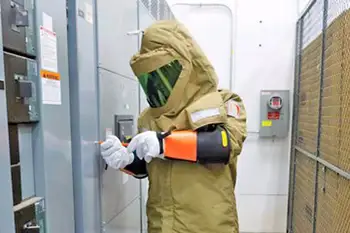
- Live Online
- 6 hours Instructor-led
- Group Training Available
Download Our OSHA 4474 Fact Sheet – Establishing Boundaries Around Arc Flash Hazards
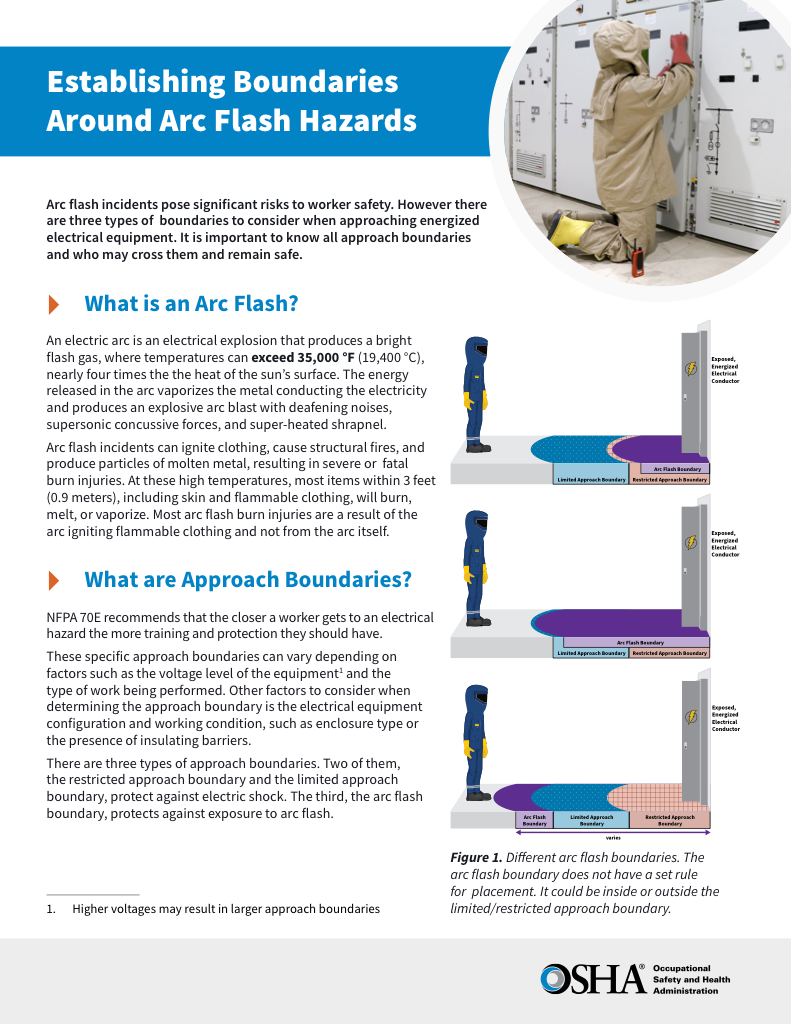
- Understand the difference between arc flash and electric shock boundaries
- Learn who may cross each boundary and under what conditions
- Apply voltage-based rules for safer approach distances
Dangers of Electricity include shock hazards, burns, fire risks, and arc flash incidents. Understanding electrical safety, including grounding, insulation, and proper equipment use, helps prevent accidents, reduce injuries, and ensure protection in homes, workplaces, and industrial environments.
Dangers of Electricity and Their Impact on Workplace Safety
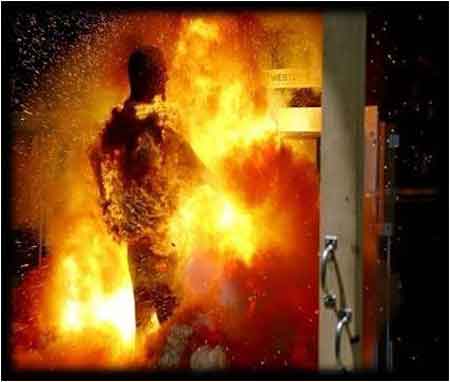
Dangers include a variety of hazards that include Electric Shock, Psychological Damage, Physical Burns, Neurological Damage and Ventricular fibrillation resulting in death. Arc flash incidents often result in devastating human consequences, and reviewing documented cases of an arc flash accident helps reinforce why strict safety controls are non-negotiable.
Any form of energy, when not properly controlled or harnessed, can result in serious danger to those who use it. The risks inherent with electric power can generally be divided into two categories: direct and indirect. The direct danger is the damage the power itself can cause to the human body, such as stopping breathing or normal heartbeats, or causing burns. The indirect dangers include damage to the human body from an electric shock, such as a fall, explosion, or fire.
Electric power at any voltage can be dangerous and should always be approached with caution. An electric shock can occur upon contact of a human or animal body with any source of voltage high enough to cause sufficient current flow through the muscles or nerves. The minimum current a human can feel is approximately one milliampere (mA). As little as 80 milliampere can seize the heart muscle. The current may cause tissue damage or heart fibrillation if it is sufficiently high. A fatal electric shock is referred to as electrocution. Understanding the broader scope of arc flash hazards is essential for workplace safety, which is why our Arc Flash safety resource hub brings together practical guidance, standards, and real-world prevention strategies.
FREE EF Electrical Training Catalog
Download our FREE Electrical Training Catalog and explore a full range of expert-led electrical training courses.
- Live online and in-person courses available
- Real-time instruction with Q&A from industry experts
- Flexible scheduling for your convenience
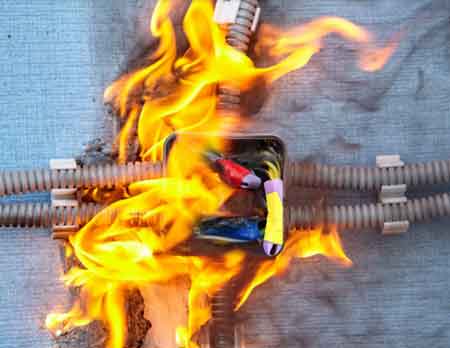
Electrical hazards can occur in many forms, from damaged electrical cords and improper use of an extension cord to overloaded electrical systems and faulty electrical equipment. Circuit breakers are designed to protect against such dangers, but OSHA electrical standards emphasize that safety depends on proper installation, inspection, and maintenance. Contact with overhead power lines remains a leading cause of personal injury and fatalities, which is why only a qualified electrician should perform high-risk tasks. To prevent electrical accidents, workers must follow safe practices, use protective equipment, and ensure that all systems meet compliance requirements.
Psychological Impact
The perception of electric shock can vary depending on several factors, including voltage, duration, current, path taken, and frequency. Current entering the hand has a threshold of perception of about 5 to 10 mA (milliampere) for DC and about 1 to 10 mA for AC at 60 Hz. Shock perception declines with increasing frequency, ultimately disappearing at frequencies above 15-20 kHz.
Prevention tips: Regular training helps workers understand perception thresholds and avoid underestimating risks.
Burns
Dangers include physical burns. High-voltage (>500 to 1000 V) shocks tend to cause internal burns due to the large amount of energy (proportional to the duration multiplied by the square of the voltage) available from the source. Damage due to current is through tissue heating. In some cases, 16 volts might be fatal to a human being when the electricity passes through organs such as the heart. The physical toll on workers is severe, with arc flash injuries ranging from deep thermal burns to permanent neurological damage and long-term disability.

Prevention tips: Wear arc-rated PPE, maintain insulation integrity, and follow lockout/tagout procedures. Thermal exposure remains one of the most serious risks, which is why understanding the mechanisms behind an arc flash burn is essential when selecting protective measures.

Ventricular fibrillation
A low-voltage (110 to 220 V), 50 or 60-Hz AC current travelling through the chest for a fraction of a second may induce ventricular fibrillation at currents as low as 60mA. With DC, a current of 300-500 mA is required. If the current has a direct pathway to the heart (e.g., via a cardiac catheter or other kind of electrode), a much lower current of less than 1 mA (AC or DC) can cause fibrillation. Fibrillations are usually lethal because all the heart muscle cells move independently. Above 200mA, muscle contractions are so strong that the heart muscles cannot move at all.
Prevention tips: Use residual-current devices (RCDs) or ground-fault circuit interrupters (GFCIs) to shut off dangerous currents instantly.
Neurological effects
Other dangers can interfere with nervous control, especially over the heart and lungs. Repeated or severe electric shock, which does not lead to death, has been shown to cause neuropathy.
When the current path is through the head, it appears that, with sufficient current, loss of consciousness almost always occurs swiftly.
Prevention tips: Keep strict approach boundaries, use insulated platforms, and wear dielectric footwear.
Arc Flash And Blast
Arc flash and arc blast will always be present on the job. Still, proper awareness, training, and the development of arc-flash safety personal protection strategies can minimize the likelihood of injury and fatalities.
The leading standard governing the calculation and determination of explosive hazard is NFPA 70E, Electrical Safety in the Workplace. This electrical safety standard encompasses the full range of electrical safety issues, from work practices and maintenance to special equipment requirements and installation. In fact, OSHA in the United States already bases its electrical safety mandates on the comprehensive information in this important Standard.
Test Your Knowledge About Arc Flash!
Think you know Arc Flash? Take our quick, interactive quiz and test your knowledge in minutes.
- Instantly see your results and score
- Identify strengths and areas for improvement
- Challenge yourself on real-world electrical topics
Electrical safety is the leading subject in the North American power industry. Electrical accidents, when they occur (and they occur every day), are extremely debilitating and often fatal, depending on the voltage and amperage involved, as well as the conditions of electrocution. As little as 80 milliamps is enough energy to put the human heart into defibrillation and death. So, this subject should be addressed with a commitment from both electrical workers and their management.
Prevention tips: Conduct arc flash studies, apply warning labels, wear appropriate PPE, and maintain safe working distances. Beyond garments, comprehensive arc flash safety gear includes face protection, gloves, and headgear designed to protect the most vulnerable parts of the body.
Workplace Safety and Prevention
-
Always treat electrical power as dangerous, regardless of voltage.
-
Follow NFPA 70E and OSHA regulations for training and protective measures.
-
Use grounding, bonding, insulation, and circuit protection devices.
-
Enforce lockout/tagout (LOTO) and maintain safe clearance boundaries.
-
Train workers regularly and refresh their awareness of safety procedures.
The dangers of electricity are real and varied, from shock and burns to arc flash explosions and fatal fibrillation. However, with proper grounding, insulation, protective equipment, and adherence to NFPA 70E and OSHA standards, these risks can be effectively mitigated. Electrical safety depends on knowledge, training, and consistent vigilance.
Related Articles
