3 Phase Power Explained
By R.W. Hurst, Editor
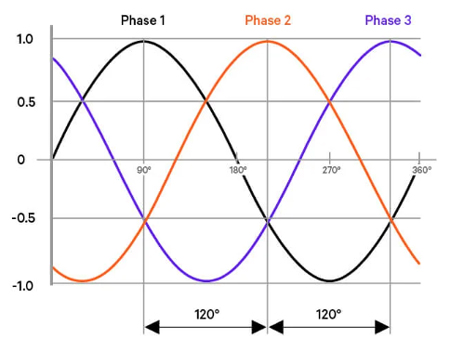
3 phase power uses three alternating currents that deliver steady voltage for motors, industrial equipment, and commercial loads. It improves efficiency, supports balanced loads, and reduces conductor size compared to single-phase systems.
Understanding How Three-Phase Power Works
3 phase power has become the standard for commercial and industrial electricity because it delivers energy in a smoother, more reliable way than single-phase service. Instead of relying on a single alternating-voltage waveform, the system uses three waveforms that rise and fall at evenly spaced intervals. The 120-degree separation between them means the combined output never drops to zero. Motors start more easily, heavy equipment runs with less vibration, and overall system stress is reduced.
A less obvious advantage is the way this arrangement uses conductors more efficiently. For the same voltage and current, a three-phase system can deliver roughly 1.73 times as much usable energy, allowing engineers to specify smaller, lighter conductors without sacrificing performance. Businesses benefit from reduced wiring costs and lower line losses. For a broader view of how electrical stability affects real installations, our Power Quality overview covers voltage balance, waveform shape, and load behavior in greater detail.
In many industrial facilities and modern data centers, phase AC power is arranged so that each waveform is separated by 120 degrees, allowing the system to deliver smoother energy across a full cycle. Engineers may choose a delta configuration when designing a phase power supply because it offers stable phase voltage and strong performance for heavy loads. This approach also improves efficiency across a transmission system, where consistent waveform spacing and balanced currents help maintain reliable three-phase power distribution.
How 3 Phase Systems Are Configured
3 phase power networks are built around two practical wiring arrangements, Wye and Delta. Each offers different benefits and is chosen based on the loads a facility needs to support.
A Wye system connects each of the three-phase conductors to a shared neutral point. This gives operators the flexibility of both line-to-line and line-to-neutral voltages. It is the arrangement most commonly found in commercial buildings because it can serve large equipment and ordinary single-phase outlets from the same source.
A Delta system connects the three phases in a triangular loop with no neutral. Many industrial plants prefer this configuration because it is simple, compact, and performs well with balanced motor loads. Delta systems are also known for their resiliency. A loss of one phase may reduce performance, but the system often continues operating long enough to avoid a full shutdown.
Wye (Y):
Provides both 3 phase and single-phase
Uses four wires
Well-suited for mixed voltage applications
Delta (Δ):
Three-wire design
Good fault tolerance
Efficient for heavy, balanced loads
If you want to explore the relationships between real, reactive, and apparent power, our guides on Apparent Power and Apparent Power vs. Real Power provide clear examples. Those pages also link directly to our Power Factor Calculator and Apparent Power Calculator for quick system checks.
Electrical Behavior and Energy Calculations
The defining trait of 3 phase power is the steady flow of power it provides. Single-phase systems deliver power in pulses. Three-phase systems deliver it almost continuously. The difference is immediately noticeable in motors, which run with smoother torque and better efficiency when fed by three synchronized waveforms.
Energy in a balanced system is typically calculated with:
P = √3 × V × I × PF
P is total power in watts
V is line-to-line voltage
I is current
PF is the power factor
The square root of three reflects the 120-degree separation of the waveforms. It shows why a three-phase network delivers more usable energy than a single-phase network operating at the same voltage and current. For guidance on grounding practices that affect safety and stability, our Electrical Grounding and Grounding and Bonding sections provide code-based explanations.
Real-World Applications and Benefits
3 phase power supports the backbone of global industry. It drives manufacturing lines, HVAC systems, refrigeration plants, elevators, pumps, compressors, server farms, and virtually every environment that depends on high-reliability equipment. Utilities rely on it for long-distance transmission, and large UPS systems depend on it to handle critical loads.
Its main advantages include:
- Stable, near continuous power delivery that reduces stress on motors
- Lower material requirements for conductors
- Smaller and more efficient motors and transformers
- Scalability for buildings and industrial campuses
When facilities manage nonlinear loads or sensitive electronics, they can limit waveform distortion by reviewing the principles outlined in our Power Quality and Harmonics guide.
In modern electrical engineering, alternating current remains the preferred method of distribution because it is well-suited to long-distance transmission. Three-phase configurations extend that advantage by reducing voltage fluctuation and improving the performance of equipment that depends on consistent torque. The presence of a neutral wire in certain systems offers additional flexibility, allowing both heavy loads and standard outlets to operate from the same distribution panel.
Challenges and Power Quality Concerns
Although 3 phase power networks offer clear advantages, they also require more careful planning. Wye systems depend on a healthy neutral conductor. If that conductor becomes loose or fails, voltage imbalances can occur, causing damage to equipment. Delta systems may be more tolerant of certain faults, but diagnosing issues within them can be more complex.
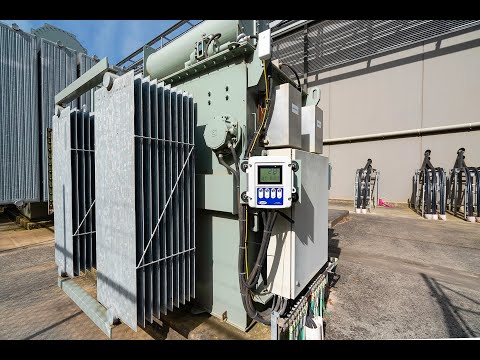

Nonlinear loads are another concern. Devices such as VFDs, LED drivers, and switching power supplies introduce harmonic distortion. These unwanted frequencies can cause heat buildup, interference, and reduced efficiency.
Engineers often address these issues with:
- Power factor correction
- Harmonic filtering
- Real-time monitoring and corrective controls
These practices support reliable operation in environments where precision equipment and high-energy loads coexist.
When 3 Phase Power Isn't Available
Some regions still receive only single-phase service from the utility. In those cases, users may need equipment that creates an artificial three-phase supply.
Common options include:
- Static converters that are simple and inexpensive
- Rotary converters that handle motor loads more effectively
- Variable frequency drives that generate a synthetic three-phase output and also provide speed control
Each solution has tradeoffs in cost, capability, and long-term reliability. For specific calculations, our Three Phase Power Calculation page includes formulas, examples, and load factor information.
Historical and Technical Context
The 3 phase power system grew out of pioneering work from the late nineteenth century. Nikola Tesla, Galileo Ferraris, and Mikhail Dolivo-Dobrovolsky demonstrated that earlier DC and single-phase systems could not match the performance of multiple, synchronized waveforms. Their findings shaped the modern grid, which now uses some variation of three-phase distribution in nearly every industrialized country.
Standards vary by region. North America uses several configurations, including a high-leg Delta for mixed load facilities. Many European countries use a 400-volt and 230-volt Wye arrangement for commercial and residential service.
Three-phase electricity is not merely a technical refinement. It is one of the enabling technologies of the modern world. Its efficiency, stability, and scalability support nearly every sector of the economy. Although the systems require knowledgeable design and installation, the long-term benefits in performance and operating cost are substantial.
Frequently Asked Questions
What is 3 phase used for?
It is used where large amounts of energy are required, including motors, HVAC systems, refrigeration, industrial machinery, and high-power equipment.
How does 3 phase power differ from a single-phase power?
Single-phase uses one alternating waveform. Three-phase uses three synchronized waveforms that deliver smoother power with fewer voltage dips.
Why is a 3-phase power more efficient?
It provides more continuous energy, reduces conductor size, lowers transmission losses, and improves motor performance.
Related Articles