Power Factor Calculator
By R.W. Hurst, Editor
Power Quality Training - Harmonic Analysis, Diagnostics, Mitigation
Our customized live online or in‑person group training can be delivered to your staff at your location.
- Live Online
- 12 hours Instructor-led
- Group Training Available
Download Our OSHA 4474 Fact Sheet – Establishing Boundaries Around Arc Flash Hazards

- Understand the difference between arc flash and electric shock boundaries
- Learn who may cross each boundary and under what conditions
- Apply voltage-based rules for safer approach distances
Power factor calculator helps evaluate electrical efficiency by comparing real power (P), apparent power (S), and reactive power (Q). It supports energy optimization, equipment sizing, and power quality analysis across industrial and commercial systems.
Electrical systems rarely signal inefficiency in obvious ways. More often, it appears indirectly, a transformer operating warmer than expected, a feeder reaching its limit sooner than design calculations suggested, or a utility bill that suddenly includes demand or power factor (PF) penalties. These are not abstract problems. They are practical signals that the relationship between load behavior and supplied energy deserves closer attention.
Power Quality Analysis Training
Request a Free Power Quality Training Quotation
A power factor calculator is useful precisely because it translates those symptoms into a measurable quantity. By relating the actual energy doing useful work to the amount the system must deliver to support it, the calculator provides a clearer picture of what is happening electrically under real operating conditions. It helps separate true load demand from reactive burden, which is often invisible until capacity or cost becomes an issue.
When used as part of normal analysis rather than as a one-time check, the results inform decisions about equipment sizing, available system headroom, and whether corrective measures make technical and economic sense. Instead of relying solely on nameplate data or assumptions, engineers and electricians gain a grounded view of how efficiently their systems are performing in practice.
When Does Power Factor Become Visible?
Electricity Today T&D Magazine Subscribe for FREE

- Timely insights from industry experts
- Practical solutions T&D engineers
- Free access to every issue
When results show excessive reactive demand, a correction calculation helps determine whether a power factor correction capacitor is appropriate and how large it should be. The goal is not to force perfection, but to correct the power factor enough that the system runs cooler, capacity is freed up, and the electrical infrastructure is no longer stressed by current that contributes little to useful output.
How a Power Factor Calculator Works
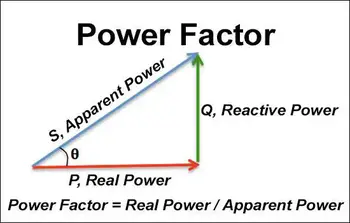
At its simplest, the calculator compares the load's actual consumption to what the source must deliver. P reflects the energy doing useful work, turning shafts, heating elements, or producing light. Apparent power represents the full electrical demand placed on the system to support that work, including the current required to establish magnetic and electric fields.
By dividing P by S, the calculator expresses this relationship as a single value between 0 and 1. A higher result means voltage and current are working together efficiently. A lower value signals that part of the current is circulating without contributing directly to the output, where losses, excess heating, and capacity constraints begin to appear. For a deeper explanation of why those values diverge, your article on apparent power vs real power provides the conceptual foundation for what the calculator shows.
In practice, this matters most in systems with motors, transformers, and other inductive loads, where power factor tends to drift as operating conditions change. Engineers rely on these calculations to avoid oversizing equipment or misinterpreting demand readings, especially when planning upgrades or troubleshooting performance issues.
If you're unsure how to compute power factor manually, our article on how power factor is calculated breaks down the process using simple formulas.


What does a power factor calculator calculate?
Rather than measuring anything directly, the calculator interprets values you already have, typically P and S taken from meters or test instruments. From those inputs, it determines how much of the supplied energy is being converted into useful output versus how much is tied up in reactive exchange.
P is the load's actual consumption. S reflects the total electrical demand placed on the supply. The difference between the two is reactive power, energy that oscillates between the source and reactive components, such as motors and transformers. While reactive power (Q) is necessary for operation, it does not perform useful work, and excessive amounts place unnecessary strain on the system.
When viewed together, these values offer insight beyond a single efficiency number. They reveal whether a circuit is operating as expected, whether loading assumptions match reality, and whether corrective measures would meaningfully improve performance. Low PF does not automatically indicate a problem, but it does point to conditions worth understanding before capacity limits or cost penalties become unavoidable.
Key Parameters in Power Factor Calculation
| Parameter | Symbol | Unit | Description |
|---|---|---|---|
| Real Power | P | Watts (W) | The actual power consumed by the load to perform useful work. |
| Apparent Power | S | Volt-Amperes (VA) | The total power supplied to the circuit, product of voltage and current. |
| Reactive Power | Q | Volt-Amperes Reactive (VAR) | Power stored and released by reactive components like inductors or capacitors. |
| Power Factor | PF | Ratio (0–1) | Ratio of real power to apparent power: PF = P / S. |
| Voltage | V | Volts (V) | Electrical potential difference across the circuit. |
| Current | I | Amperes (A) | Flow of electric charge in the circuit. |
| PF Correction Capacitor | C | Farads (F) | Added capacitance used to reduce reactive power and improve PF. |
Steps to calculate power factor
Calculating power factor manually follows the same logic as the calculator. First, determine the P drawn by the load using appropriate metering. Next, determine S by multiplying the measured voltage and current. Dividing real power by apparent power yields the power factor. Use our apparent power calculator to input your voltage and current values before determining the PF.
A result close to 1 indicates that most of the supplied current is directly contributing to useful work. Lower values indicate higher reactive demand, often caused by inductive equipment operating below optimal conditions. While correction is sometimes appropriate, the result should always be interpreted in the context of load behavior, duty cycle, and system design, rather than treated as an isolated number. Learn the differences between leading vs lagging power factor and how they affect the accuracy of your power factor calculator.
Test Your Knowledge About Power Quality!
Think you know Power Quality? Take our quick, interactive quiz and test your knowledge in minutes.
- Instantly see your results and score
- Identify strengths and areas for improvement
- Challenge yourself on real-world electrical topics
Power factor correction
Power factor correction is not about chasing perfection, but about restoring balance. By adding capacitive elements to counteract inductive effects, reactive demand can be reduced, freeing system capacity and lowering losses. The process begins by identifying the existing PF and establishing a realistic target, which is rarely exactly one.
Q is calculated based on the phase relationship between voltage and current, and from that value, the required capacitance can be estimated. In real installations, correction is typically applied incrementally and verified under operating conditions, rather than calculated once and assumed correct.
Correction decisions must follow a proper system assessment. Overcorrection can introduce new problems, including voltage instability and resonance. For this reason, power factor correction should always be designed and implemented by qualified personnel who understand the system's behaviour as a whole. In facilities with fluctuating loads, a good automatic power factor controller is often used to dynamically adjust compensation, maintaining efficiency without unintended side effects.
Related Articles
