Sub-Saharan Africa has a huge electricity problem - but with challenge comes opportunity
High Voltage Maintenance Training Online
Our customized live online or in‑person group training can be delivered to your staff at your location.
- Live Online
- 12 hours Instructor-led
- Group Training Available
Sub-Saharan Africa Energy Access faces critical deficits; SDG7, clean energy finance, off-grid solar, and microgrids drive electrification for health, education, and economy amid World Bank and IEA efforts to expand reliable, affordable power.
What's Happening
Reliable, affordable power in sub-Saharan Africa via renewables, off-grid solar, and SDG7-led electrification.
759M lacked power in 2019; 3/4 lived in Sub-Saharan Africa.
SDG7 targets universal, affordable, reliable, modern energy by 2030.
Clean energy finance reached $17B in 2018 for developing nations.
Off-grid solar, microgrids expand access for health, schools, business.
World Bank, IEA back scalable, reliable, low-cost electrification.
Sub-Saharan Africa has an electricity problem. While the world as a whole has made great strides when it comes to providing access to electricity and moving toward universal electricity access worldwide (the world average is now 90 per cent with access, up from 83 per cent in 2010), southern and western African states still lag far behind.
According to Tracking SDG7: The Energy Progress Report, produced by a consortium of organisations including the World Bank, the International Energy Agency and the World Health Organization, 759 million people were without electricity in 2019 and threequarters of them were based in sub-Saharan Africa. At just seven per cent, South Sudan had the lowest access figures; Chad, Burundi and Malawi were only marginally higher. What’s more, due to a combination of factors, the situation is getting worse. In total, the region’s access deficit increased from 556 million people in 2010 to 570 million people in 2019.
These days, being without electricity has an impact on every sphere of life. The Covid-19 pandemic only served to put this into sharper relief. Intermittent electricity meant vaccination doses that rely on cold storage were impossible to deliver and, as more than 70 per cent of the health facilities in sub-Saharan Africa have no access to reliable electricity, the problem was vast. But even without a global pandemic, having no power stymies opportunity in every field, from education to economics.
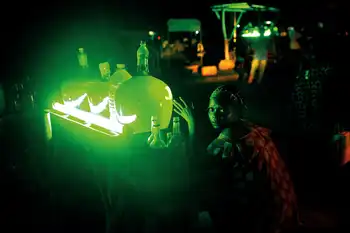
French photojournalist Pascal Maitre, who has spent much of his career writing about sub-Saharan Africa, wanted to document the problems faced by people in areas with no electricity. He thought particularly carefully about the location for his project. ‘First, I was thinking I could take images in the Democratic Republic of the Congo,’ he says. ‘But then I thought that if you chose a place that has war, it’s logical that electricity won’t really work. So, instead, I wanted to find a place that is quite stable. I decided to go to Benin, where they have a democracy. It is a good example of a country that’s not in really bad shape but where they still have this problem. Also, I didn’t want to go to a place that is very remote, where it is normal not to have good service. So I decided to go to a place around 50 kilometres from the capital that you can get to by road.’
Maitre visited several villages in the region, as well as making trips to Chad and Senegal, and encountered the full range of limitations engendered by the power shortage. From teachers struggling to conduct lessons in the dark to midwives forced to work with only the weak light from a phone, the situation was clearly unacceptable. ‘People were very, very, very upset,’ he says. ‘I conducted a lot of interviews in different villages and lack of electricity touches education, economy, business, security and also emigration, because people have to move to big cities or maybe to Europe to get jobs.’
Where once the situation might have been accepted as the norm, people today are fully aware of the ways in which they are held back by the lack of power. As Maitre remembers: ‘A guy said to me one day, “Do you think it is normal that last time my wife delivered a baby, the midwife had to hold her phone between her teeth in order to see what she was doing?” You feel very frustrated.’ He adds that the fact that most people now have mobile phones only highlights the hardship. ‘Before, maybe it was not so frustrating. But now, most of these people have cellphones. The cellphone company puts antennae everywhere so the phones work, but people cannot recharge their phones. They have to go to the market, where someone will come with a generator to recharge.’
Governments and global organisations are very aware of the problem across the world as a whole. Sustainable Development Goal 7 (SDG7) – one of the 17 goals set out in 2015 by the United Nations General Assembly – was designed to ensure universal access to affordable, reliable, sustainable and modern energy by 2030, underscoring the push for clean, affordable and sustainable electricity for all by 2030. As part of this goal, international financial flows to developing countries in support of clean energy reached US$17 billion in 2018. As a result, some areas have seen huge improvement. According to the Energy Progress Report, in Latin America and the Caribbean, and in Eastern and South-Eastern Asia, the advance of electrification has been enough to approach universal access. By 2019, in Western Asia and North Africa, and Central and South Asia, 94 and 95 per cent of the population respectively had access to electricity.




But these statistics only serve to emphasise just how bad the situation is in sub-Saharan Africa, where electricity systems are unlikely to go green this decade according to several analyses. As the report states: ‘While renewable energy has demonstrated remarkable resilience during the pandemic, the unfortunate fact is that gains in energy access throughout Africa are being reversed: the number of people lacking access to electricity is set to increase in 2020, making basic electricity services unaffordable for up to 30 million people who had previously enjoyed access.’
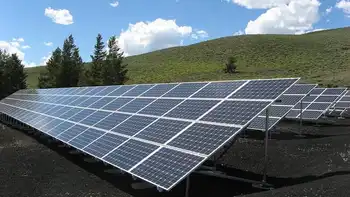
The small silver lining is that if the situation is dealt with properly, the region could build a renewable-energy system from the ground up, rather than having to undergo the costly and complex transitions underway in developed countries. In rural areas, small-scale or off-grid renewable systems (mostly solar) are expected to play an important role, as highlighted by a recent IRENA report on decarbonisation, in increasing access. In fact, solar panels are already used in many areas. In 2019, 105 million people had access to off-grid solar solutions, up from 85 million in 2016, and almost half lived in sub-Saharan Africa, with 17 million in Kenya and eight million in Ethiopia.
Rachel Kyte is currently serving as the 14th dean of the Fletcher School at Tufts University in the USA, but her CV is long. She was previously CEO of the UN-affiliated Sustainable Energy for All (SeforALL), as well as the World Bank Group vice president and special envoy for climate change, leading the run-up to the Paris Agreement. According to her, a focus on renewables is absolutely essential, both for wider efforts to tackle climate change, with some advocating a fossil fuel lockdown to drive a climate revolution, but also for the people of sub-Saharan Africa. ‘The fossil fuel industry has said it will just extend the centralised fossil-fuel power systems that we have today to reach these people,’ she says.