Power Transformers
Substation Maintenance Training
Our customized live online or in‑person group training can be delivered to your staff at your location.
- Live Online
- 12 hours Instructor-led
- Group Training Available
Download Our OSHA 3875 Fact Sheet – Electrical PPE for Power Industry Workers
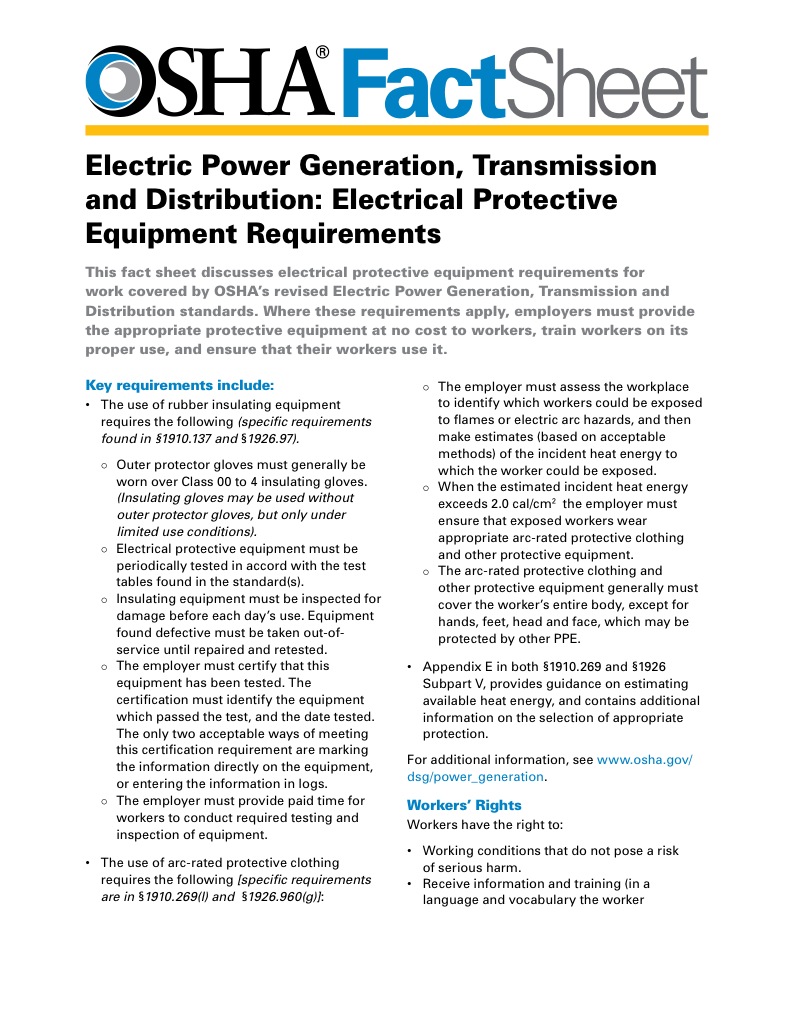
- Follow rules for rubber gloves, arc-rated PPE, and inspection procedures
- Learn employer obligations for testing, certification, and training
- Protect workers from arc flash and electrical shock injuries
Power transformers convert voltage levels for transmission and distribution, enabling step-up/step-down operation, efficient load management, insulation coordination, low losses, and reliable grid integration in substations, industrial plants, and renewable energy systems.
How Power Transformers Work
Power Transformers Directory at The Electricity Forum contains a listing of electrical power transformers, power and distribution transformer manufacturers and suppliers, transformer service and transformer maintenance facilities, transformer protection companies, electrical transformer rental and repair, transformer monitoring equipment, electrical transformer testing, power transformer manufacturing companies, distribution transformer companies, and the following subcategories: For readers mapping the broader grid context, our resource on what an electrical substation is explains how transformer assets interface with switching yards and feeders.
To understand related equipment that often operates alongside transformers, see the overview of electrical substation components for typical layouts and roles.
They are used to "transform" voltage from one level to another, usually from a higher voltage to a lower voltage. They do this by applying the principle of magnetic induction between coils to convert voltage and/or current levels.
Because transformers operate at system frequency, this primer on electrical frequency supply clarifies implications for regulation, losses, and interoperability.
In measurement and protection schemes, a capacitor voltage transformer in a substation provides scaled voltage signals that complement power transformer functions.
In this way, they are a passive device which changes alternating current (otherwise known as "AC") electric energy from one circuit into another through electromagnetic induction. This device normally consists of a ferromagnetic core and two or more coils called "windings". A changing current in the primary winding creates an alternating magnetic field in the core. In turn, the core multiplies this field and couples the most of the flux through the secondary windings. This in turn induces alternating voltage (or emf) in each of the secondary coils.
Sign Up for Electricity Forum’s Electrical Substations Newsletter
Stay informed with our FREE Electrical Substations Newsletter — get the latest news, breakthrough technologies, and expert insights, delivered straight to your inbox.
Selection of core materials and winding arrangements ties directly to electrical substation design considerations such as insulation coordination and short-circuit withstand.
Coordinated relaying ensures safe operation, and our guide to substation protection shows how CTs, VTs, and protective functions work with transformer characteristics.
Modern monitoring practices are increasingly digital, with substation automation enabling condition-based maintenance and remote diagnostics.