Electrical Substation Components Explained
By R.W. Hurst, Editor
Substation Maintenance Training
Our customized live online or in‑person group training can be delivered to your staff at your location.
- Live Online
- 12 hours Instructor-led
- Group Training Available
Download Our OSHA 4475 Fact Sheet – Being Aware of Arc Flash Hazards
- Identify root causes of arc flash incidents and contributing conditions
- Apply prevention strategies including LOTO, PPE, and testing protocols
- Understand OSHA requirements for training and equipment maintenance
Electrical substation components include transformers, circuit breakers, busbars, relays, and control systems that manage voltage, protect equipment, and support reliable transmission and distribution of electricity across modern power networks.
Electrical Substation Components
Electrical substations form the backbone of transmission and distribution networks by controlling voltage, directing power flow, and protecting critical infrastructure. Rather than acting as passive junctions, substations actively manage how electricity moves from generation sources to end users. Each component plays a defined role, and the system only functions reliably when those elements operate together as intended. Understanding what is an electrical substation provides the context for how breakers, busbars, insulators, and protective devices work together to keep the grid reliable and safe.
Electrical substations serve as the interface between transmission infrastructure and downstream networks, where power is stepped down and routed into regional and local delivery systems that form the backbone of electric power distribution.
Why Electrical Substation Components are Important
Substations handle some of the most demanding conditions in the electrical grid. High voltages, heavy fault currents, and continuous operation mean that even minor component failures can have widespread consequences. Understanding how substation equipment works together helps engineers, technicians, and operators make informed decisions about design, maintenance, and system upgrades. It also supports safer work practices by clarifying where hazards exist and how protective systems respond under abnormal conditions.
Among the key devices used to step voltage down for local distribution, the pad mounted transformer provides a compact, enclosed option that integrates safely with other substation components.
They handle voltage-level conversion, protect critical equipment, and support the efficient transmission and distribution of energy across the grid. Whether part of long-distance transmission corridors or local distribution substations, these systems ensure electricity is delivered safely, consistently, and with minimal losses. Understanding what an electrical substation is provides essential context for how breakers, busbars, insulators, and protection systems interact to keep the grid stable.
FREE EF Electrical Training Catalog
Download our FREE Electrical Training Catalog and explore a full range of expert-led electrical training courses.
- Live online and in-person courses available
- Real-time instruction with Q&A from industry experts
- Flexible scheduling for your convenience
Electrical Transformer Maintenance Training
Substation Maintenance Training
Request a Free Training Quotation
Core Components of Substation Equipment
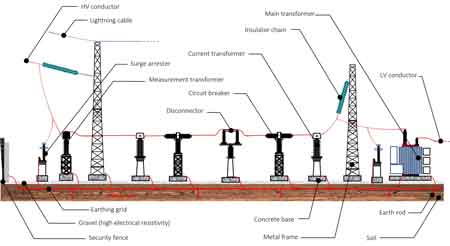
Every substation is built around a small set of essential components that govern power flow and system protection. At the center is the power transformer, which changes voltage levels to match transmission or distribution requirements. Raising the voltage reduces current and losses over long distances, while lowering it allows customers to use electricity safely.
Power transformers work alongside circuit breakers, which interrupt current when faults occur. These breakers isolate damaged sections of the system before equipment is destroyed or safety is compromised. Instrument transformers, including current and voltage transformers, provide precise measurements to relays and control systems without exposing them to hazardous voltages.
Busbars serve as the substation's internal highways, distributing power from incoming lines to transformers and to outgoing feeders. Insulators support energized conductors while preventing unintended current paths. Lightning arresters protect equipment by diverting surge energy to ground during lightning strikes or switching events. Capacitor banks improve voltage stability and power factor, while protective relays continuously monitor conditions and initiate breaker operations when abnormal behaviour is detected. Disconnect switches provide visual isolation, allowing equipment to be safely serviced. You can read more about their role in our article on the capacitor voltage transformer in a substation.
Electrical Substation Components – Roles and Control Functions
Each substation component serves a specific operational purpose within the overall system. Transformers manage voltage levels across grid segments, while relays and breakers form the first line of defence against faults. Accurate data from current and voltage transformers allows control systems to respond quickly to load changes, faults, or abnormal operating conditions.
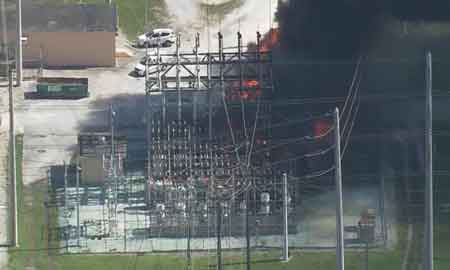
In many distribution substations, capacitor banks play a key role in maintaining voltage profiles and reducing reactive power flow. By improving power factor, they lower losses and reduce stress on upstream equipment. Together, these elements support reliable system operation and consistent power quality across the network.
Types and Configurations of Substations
Substation design varies depending on location and function. Step-up substations near generating stations raise voltage for transmission, while step-down substations reduce voltage for distribution networks. Switching substations focuses on routing power rather than changing voltage, allowing operators to redirect flows during maintenance or emergencies.
Substations may be installed indoors or outdoors, depending on voltage levels, space constraints, and environmental conditions. Distribution substations typically serve as the final point of transformation before electricity reaches homes and commercial facilities. Specialized layouts, such as tie substations, provide additional operational flexibility within complex networks.
Like those described in our electrical substation design guide, distribution substations are the final conversion point before electricity reaches homes and businesses. Switching substations primarily directs power flows, enabling flexibility in transmission line routing. Substations are also classified as indoor or outdoor, based on whether their components are housed in buildings or exposed to the environment.
Safety Measures in Substation Operation
Safety is a primary concern in all substation environments. High voltages and fault currents create serious hazards if not properly controlled. Earthing systems provide a low-impedance path for fault currents, reducing touch and step potentials during abnormal events. Physical barriers and fencing restrict access to energized equipment, while fire detection and suppression systems limit damage in the event of failures.
Electricity Today T&D Magazine Subscribe for FREE

- Timely insights from industry experts
- Practical solutions T&D engineers
- Free access to every issue
Personnel protection relies on clear procedures, appropriate personal protective equipment, and a thorough understanding of system status before work begins. These measures work together to reduce risk while maintaining reliable operation. Read our in-depth guide on substation protection for more on safety protocols and equipment.
Automation and Control Rooms in Modern Substations
Modern substations increasingly rely on automation and digital control. SCADA systems link field devices with centralized control rooms, allowing operators to monitor conditions and respond to events in real time. Intelligent electronic devices and remote terminal units collect data, execute protection logic, and communicate directly with control systems.
This shift toward automation improves reliability, reduces outage durations, and supports predictive maintenance strategies. The digital substation represents an evolution in how electrical networks are monitored and managed, integrating protection, control, and communication into a unified system.
Frequently Asked Questions
What are the main components of a substation?
A typical substation includes power transformers, circuit breakers, instrument transformers, busbars, capacitor banks, disconnect switches, lightning arresters, and control systems.
What is the function of a capacitor bank?
Capacitor banks supply reactive power, helping stabilize voltage and improve power factor within the electrical system.
How does SCADA improve substation performance?
SCADA enables real-time monitoring and remote control, reducing response time to faults and improving overall operational efficiency.
Related Articles
