Excitation Current
By Frank Baker, Associate Editor
Transformer Maintenance Training - Testing and Diagnostics
Our customized live online or in‑person group training can be delivered to your staff at your location.
- Live Online
- 12 hours Instructor-led
- Group Training Available
Download Our OSHA 4474 Fact Sheet – Establishing Boundaries Around Arc Flash Hazards

- Understand the difference between arc flash and electric shock boundaries
- Learn who may cross each boundary and under what conditions
- Apply voltage-based rules for safer approach distances
Excitation current establishes transformer core flux and reflects magnetic losses, efficiency, and structural condition. Tracking its behavior helps detect core degradation, rising losses, and reliability risk long before visible failure occurs.
Excitation current is not a background electrical detail. In transformer operation, it is a diagnostic signal that reflects core magnetizing behavior, internal loss mechanisms, and early indications of structural or material change. Engineers and maintenance professionals rely on its behavior not to understand what a transformer is doing in theory, but to judge what is happening inside it in practice.
A transformer draws current even when its secondary is open, and no load is connected. That current exists solely to establish and sustain the magnetic flux in the core. Without it, no voltage transformation could occur. Yet the importance of excitation current (EC) lies not in its existence, but in what its behavior reveals about magnetic efficiency, core condition, and long-term reliability.
Excitation current behavior is best understood in the context of magnetic path integrity, which is why transformer core condition remains central to long-term reliability, as explained in Transformer Core.
In a healthy transformer, excitation current follows predictable patterns defined by core design, material properties, and operating voltage. When those patterns change, the transformer is communicating. Sometimes the message is benign, such as a normal temperature influence or a voltage variation. Other times it signals core stress, insulation aging, mechanical displacement, or emerging magnetic path defects. The professional task is not simply to measure the excitation current, but to interpret its behavior.
FREE EF Electrical Training Catalog
Download our FREE Electrical Training Catalog and explore a full range of expert-led electrical training courses.

- Live online and in-person courses available
- Real-time instruction with Q&A from industry experts
- Flexible scheduling for your convenience
Because magnetizing behavior is shaped by winding geometry and insulation structure, changes in excitation current often correlate with deterioration described in Transformer Insulation.
Why Excitation Current Matters in Real Systems
Excitation current governs core losses, which exist regardless of load. Those losses shape efficiency, thermal behavior, and long-term insulation stress. Because they do not scale with output power, they quietly influence operating cost and aging even when the transformer appears lightly loaded.
More importantly, the excitation current reflects magnetic integrity. When it rises without a clear operating explanation, it often indicates that the magnetic circuit is no longer behaving as designed. Increased hysteresis loss, abnormal eddy-current effects, or partial saturation can all manifest first through subtle excitation changes, long before catastrophic failure becomes visible.
When excitation current trends upward over time, it should be evaluated alongside broader asset diagnostics, as outlined in the Power Transformers Health Check.
For this reason, EC is a reliability indicator, not just an electrical parameter. It contributes to voltage regulation behavior, reactive power balance, and protective coordination margins. When misunderstood, it allows inefficiencies and magnetic degradation to progress unnoticed.
Interpreting Excitation Current in Practice
Professionals rarely rely on a single absolute excitation current value. Interpretation is based on comparison and behavior.
Baseline values established during factory testing or commissioning define what normal looks like for a specific transformer. Subsequent measurements gain meaning only when compared against that baseline under similar operating conditions. A slow upward drift, even if still within nameplate tolerance, is often more important than a single high reading.
In oil-filled units, abnormal excitation behavior may also reflect internal thermal or chemical changes identified through Transformer Oil Analysis.

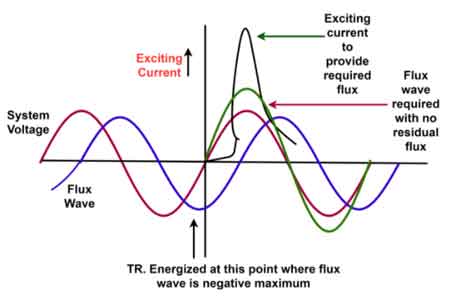
Waveform behavior matters as much as magnitude. Because magnetization is nonlinear, EC rarely follows a perfect sinusoid. Distortion patterns, harmonic content, and phase relationships provide insight into saturation effects and magnetic path conditions. These characteristics influence the performance of protective devices and help distinguish between normal magnetizing behavior and structural change.
Because magnetic performance depends on flux creation, understanding What Causes Voltage to Be Induced in a Transformer helps explain why excitation current responds so strongly to voltage variation.
Excitation current also gains meaning when interpreted alongside other diagnostic results. Loss tests, insulation resistance, impedance measurements, and temperature data together form a decision framework. No single measurement stands alone.
Measuring Excitation Current for Decision Use
Excitation current is measured by applying a rated or controlled voltage to the primary winding with the secondary open. The measurement captures both current magnitude and waveform behavior.
Professional practice focuses on three elements:
First, voltage stability during the test, because the excitation current varies strongly with applied voltage.
Second, waveform shape, because saturation and core irregularities appear there before they dominate the RMS values.
Third, a historical comparison, because trends reveal deterioration earlier than absolute thresholds.
The interpretation of excitation current also benefits from awareness of the transformer's structural layout, as described in Transformer Design, where magnetic efficiency and loss paths are established.
The purpose of measurement is not to record a number. It is to support judgment.
What Abnormal Excitation Current Indicates
Abnormally high excitation current often indicates magnetic saturation, core damage, insulation breakdown affecting magnetic coupling, or sustained overvoltage exposure. In these conditions, losses increase, efficiency declines, and thermal stress accelerates aging.
Test Your Knowledge About Utility Transformers!
Think you know Utility Transformers? Take our quick, interactive quiz and test your knowledge in minutes.
- Instantly see your results and score
- Identify strengths and areas for improvement
- Challenge yourself on real-world electrical topics
Phase imbalance in the excitation current may indicate localized core issues or mechanical displacement. Excessive distortion suggests nonlinear magnetic behavior that can challenge protection systems and affect system stability.
For long-term reliability programs, excitation current should be evaluated as part of modern asset strategies, as discussed in Condition Monitoring in an Age of Modernization.
While transformers may continue operating under these conditions, they do so with reduced margin and increased risk. Excitation current provides an early warning, long before failure becomes externally visible.
Excitation Current and Transformer Efficiency
Because excitation current is directly tied to core losses, it influences efficiency regardless of load. Every increase in magnetizing demand converts into heat and long-term insulation stress. Over years of operation, these losses shape reliability more than many load-related effects.
This is why transformer design emphasizes the quality of the core material, the lamination structure, and the magnetic path geometry. Excitation current is the operational reflection of those design choices. This is because it is a small current with a disproportionate influence. It explains why transformers consume power at no load, why magnetic design determines efficiency, and why core condition governs long-term reliability.
For engineers and maintenance professionals, understanding excitation current transforms what appears to be background noise into a meaningful diagnostic signal. It becomes an early indicator of efficiency loss, magnetic degradation, and reliability risk.
It is not a number to memorize. It is a signal to interpret.
