What Is a Motor Control Center?
By R.W. Hurst, Editor
Motor Control Training
Our customized live online or in‑person group training can be delivered to your staff at your location.
- Live Online
- 12 hours Instructor-led
- Group Training Available
Download Our OSHA 4475 Fact Sheet – Being Aware of Arc Flash Hazards
- Identify root causes of arc flash incidents and contributing conditions
- Apply prevention strategies including LOTO, PPE, and testing protocols
- Understand OSHA requirements for training and equipment maintenance
A motor control center is a centralized assembly that houses motor starters, protection devices, drives, and control equipment used to operate devices safely in industrial and commercial facilities, improving reliability, maintenance access, and coordinated motor control.
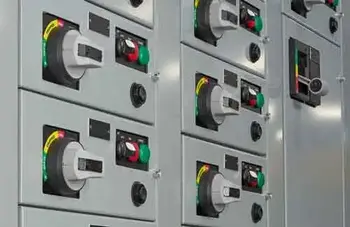
Walk through any processing plant, pumping station, or large mechanical room, and you will eventually arrive at the same destination. A long lineup of enclosed sections, usually humming quietly behind closed doors, where most of the devices in the facility are started, protected, and controlled. That lineup is the motor control center, commonly called an MCC.
Rather than scattering motor starters and protection devices throughout a building, a motor control center brings them together into a single, organized location. This approach simplifies power distribution, improves visibility into operation, and makes troubleshooting far more manageable when something goes wrong. Over time, the MCC has evolved from a simple starter cabinet into a central nervous system for device-driven processes.
How is a Motor Control Center Built?
A motor control center is not a single panel but an assembly of enclosed sections arranged side by side. Each section contains one or more removable or fixed units dedicated to a specific device or load. These units are fed from common power buses that run through the lineup, allowing multiple devices to be supplied from a single incoming source.
Behind the doors, the structure is deliberate. Vertical and horizontal bus systems distribute power safely across the lineup, while individual control sections house starters, protection devices, and disconnects. In practice, this layout allows maintenance teams to isolate one device without shutting down an entire process, a detail that matters greatly in continuous or critical operations.
Test Your Knowledge About Motors and Drives!
Think you know Motors and Drives? Take our quick, interactive quiz and test your knowledge in minutes.
- Instantly see your results and score
- Identify strengths and areas for improvement
- Challenge yourself on real-world electrical topics
Motor Starters Inside an MCC
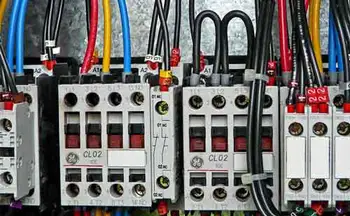
The starter is the heart of each motor control center unit, and the choice of starter directly impacts device behaviour, mechanical stress, and energy use. Smaller devices often rely on direct-on-line starters, where full voltage is applied immediately. Larger or more sensitive loads may use star-delta or soft starters to reduce inrush current and mechanical shock during startup.
Variable frequency drives are now common in modern motor control centers, particularly where speed control, torque regulation, or energy efficiency are priorities. Their presence changes how a motor control center is used day to day, shifting it from a simple starting point into a tool for process control. A deeper explanation of how these devices function together is covered in Electric Motor Control: Starters and VFDs.
Safety and Design Considerations
Safety is not an accessory in a motor control center. It is built into the structure, the spacing, the protection devices, and the way work is performed around it. Construction standards govern enclosure design and fault containment, while electrical codes define how motor control centers are installed and protected.
Arc flash risk, in particular, influences how MCCs are labeled, maintained, and accessed. Clear labeling, proper protective equipment, and controlled work practices are essential when operating or servicing energized sections. Sound design and proper application also help reduce stress and fault conditions, as explored further in Electric Motor Design Engineering.
MCCs in Automated Facilities
Modern motor control centers rarely operate in isolation. They are commonly integrated with programmable controllers, human-machine interfaces, and plant networks, allowing operators to monitor device status from a control room or workstation. This integration enables tracking current, temperature, run time, and fault history in real time.



So-called smart motor control centers extend this capability further by supporting predictive maintenance and energy monitoring. When implemented well, they provide early warning of developing problems rather than reacting to failures after the fact. More context on these systems can be found in Industrial Automation And Communication Networks.
Efficiency and Maintenance in MCC Applications
An ignored motor control center will eventually manifest as downtime. Routine inspections, infrared scanning, and verification of protective settings help catch issues such as loose connections, overheating, or misapplied overloads before they escalate. Because MCCs centralize motor control equipment, maintenance activities tend to be more efficient and less disruptive than in scattered installations.
In most facilities, a motor control center MCC serves as the practical hub where motor control equipment is brought together in a central location rather than scattered across multiple rooms or enclosures. Within these lineups, individual control panels are arranged along a common power bus, allowing each circuit to be fed, protected, and isolated in an orderly way.
A typical unit may include a combination starter that integrates short-circuit protection, overload sensing, and switching into a single assembly, along with a clearly defined power disconnect that lets maintenance personnel safely isolate equipment without disrupting the rest of the system.
Motor performance and energy use are closely tied to maintenance quality. Facilities looking to reduce operating costs often find meaningful gains by focusing on motor condition and alignment, topics covered in Electric Motor Maintenance and Diagnostics and Efficiency Opportunities Through Motor Maintenance.
Choosing the Right Equipment for Your Application
Designing or upgrading an motor control centeris rarely a one-size-fits-all exercise. Motor ratings, starting characteristics, environmental conditions, and process criticality all influence component selection. Overload protection, short-circuit ratings, and isolation methods must align with both the device and the system it serves.
Electricity Today T&D Magazine Subscribe for FREE

- Timely insights from industry experts
- Practical solutions T&D engineers
- Free access to every issue
When these decisions are made carefully, the result is a motor control center that supports reliable operation rather than becoming a recurring problem. The role of protective devices in that reliability is explained further in Electric Motor Protection.
Frequently Asked Questions
What components are typically included?
An MCC unit may include motor starters, circuit breakers or fuses, overload relays, disconnects, and increasingly, variable frequency drives. The exact mix depends on evice size and application.
What is the purpose of an MCC?
A motor control center centralizes control and protection so devices can be operated safely, maintained efficiently, and integrated into larger control systems.
How is an MCC different from a PLC?
A motor control center houses the hardware that starts and protects the device. A PLC is a controller that issues commands. They often work together but serve different roles.
Is a VFD considered an MCC?
No. A VFD is a device. A motor control center is the assembly that may contain one or more VFDs along with other control and protection equipment.
How are MCCs used in industrial settings?
They support pumps, fans, compressors, conveyors, and process equipment by providing organized, coordinated motor control suited to the demands of industrial operation.
Related Articles

