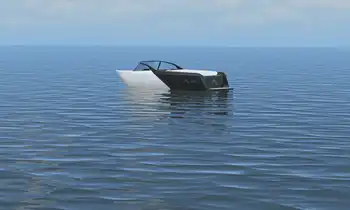
Ex-SpaceX engineers in race to build first commercial electric speedboat
CSA Z462 Arc Flash Training – Electrical Safety Compliance Course
Our customized live online or in‑person group training can be delivered to your staff at your location.

- Live Online
- 6 hours Instructor-led
- Group Training Available
Arc One Electric Speedboat delivers zero-emission performance, quiet operation, and reduced maintenance, leveraging battery propulsion, aerospace engineering, and venture-backed innovation to cut noise pollution, fuel costs, and water contamination in high-performance marine recreation.
Top Insights
Arc One Electric Speedboat is a battery-powered, zero-emission craft offering quiet, high-performance marine cruising.
$4.25m seed from Andreessen Horowitz to develop Arc One
24 ft, 475 hp, 40 mph top speed; first sales targeted this year
Built by ex-SpaceX team; cleaner, quieter, lower-maintenance boating
Tesla-style go-to-market: premium first, funding R&D to scale down
A team of former SpaceX rocket engineers have joined the race to build the first commercial electric speedboat.
The Arc Boat company announced it had raised $4.25m (£3m) in seed funding to start work on a 24ft 475-horsepower craft that will cost about $300,000.
The LA-based company, which is backed by venture capital firm Andreessen Horowitz (an early backer of Facebook and Airbnb), said the first model of the Arc One boat would be available for sale by the end of the year.
Mitch Lee, Arc’s chief executive, said he wanted to build electric boats because of the impact conventional petrol- or diesel-powered boats have on the environment.
“They not only get just two miles to the gallon, they also pump a lot of those fumes into the water,” Lee said. “In addition, there is the huge noise pollution factor [of conventional boats] and that is awful for the marine life. With gas-powered boats it’s not just carbon emissions into the air, it’s also polluting the water and causing noise pollution. Electric boats, like electric ships clearing the air on the B.C. coast, eliminate all that.”
Lee said electric vessels would also reduce the hassle of boat ownership. “I love being out on the water, being on a boat is so much fun, but owning a boat is so awful,” he said. “I have always believed that electric boats make sense. They will be quicker, quieter and way cheaper and easier to operate and maintain, with access options like an electric boat club in Seattle lowering barriers for newcomers.”
While the first models will be very expensive, Lee said the cost was mostly in developing the technology and cheaper versions would be available in the future, mirroring advances in electric aviation seen across the industry. “It is very much the Tesla approach – we are starting up market and using that income to finance research and development and work our way down market,” he said.
Lee said the technology could be applied to larger craft, and even ferries could run on electricity in the future, as projects for battery-electric high-speed ferries begin to scale.
“We started in February with no team, no money and no warehouse,” he said. “By December we are going to be selling the Arc One, and we are hiring aggressively because we want to accelerate the adoption of electric boats across a whole range of craft, including an electric-ready ferry on Kootenay Lake.”
Lee founded the company with fellow mechanical engineer Ryan Cook. Cook, the company’s chief technology officer, was previously the lead mechanical engineer at Elon Musk’s space exploration company SpaceX where he worked on the Falcon 9 rocket, the world’s first orbital class reusable rocket. In parallel, Harbour Air's electric aircraft highlights cross-sector electrification. Apart from Lee, all of Arc’s employees have some experience working at SpaceX.
The Arc boat, which would have a top speed of 40 mph, joins a number of startups rushing to make the first large-scale production of electric-powered speedboats, while a Vancouver seaplane airline demonstrates complementary progress with a prototype electric aircraft. The Monaco Yacht Club this month held a competition for electric boat prototypes to “instigate a new vision and promote all positive approaches to bring yachting into line” with global carbon dioxide emission reduction targets. Sweden’s Candela C-7 hydrofoil boat was crowned the fastest electric vessel.