SaskPower exploring geothermal power plant in efforts to reach 2030 targets
NFPA 70b Training - Electrical Maintenance
Our customized live online or in‑person group training can be delivered to your staff at your location.

- Live Online
- 12 hours Instructor-led
- Group Training Available
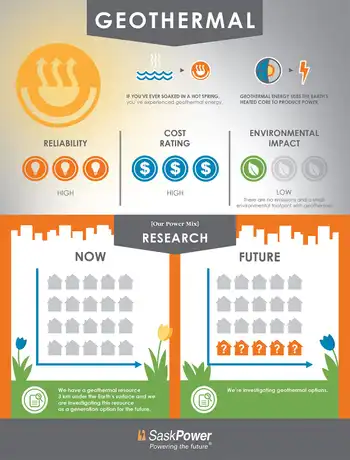
SaskPower Geothermal Power aims to deliver renewable baseload energy in Saskatchewan, complementing wind and solar. With DEEP's 5 MW pilot near Estevan tapping aquifers, it supports grid reliability alongside LED streetlights and flare gas.
The Main Points
SaskPower Geothermal Power is a baseload plan using DEEP's aquifers to deliver zero-emission power in Saskatchewan.
First utility-scale geothermal in Saskatchewan and Canada
5 MW pilot; aquifer at ~3.4 km depth heats binary cycle turbine
Provides firm 24/7 power, complements wind, solar on Sask grid
PPA signed; target in-service ~2 years; 200 MW field potential
High upfront costs, multi-unit buildout; imports from Manitoba aid
It would be a first for Saskatchewan and Canada.
SaskPower‘s efforts to double renewable electricity by 2030 could potentially include geothermal power stations.
Regina and Saskatoon areas were selected to provide a range of settings to test the new LED streetlights SaskPower is piloting. SaskPower pilot project converting streetlights to LED
The second project in SaskPower’s flare gas power generation program is contributing 750 kilowatts of electricity to Saskatchewan’s power grid. SaskPower turning waste flare gas into electricity
SaskPower reporting power outages in some regions as high winds sweep across Saskatchewan. SaskPower launches homeowner energy efficiency assessment tool
“If projections hold true, we’re going to need to find over 2,000 megawatts of renewable power,” Kirsten Marcia, president and CEO of Deep Earth Energy Production (DEEP), said.
“Geothermal is not the only solution here, but we hope to have a very significant place at the table.”
With a power purchase agreement with SaskPower signed in May, and ongoing initiatives such as purchasing power from Flying Dust First Nation to diversify supply, DEEP hopes to build a five megawatt, zero emission power plant near Estevan, where subterranean water is the warmest in Saskatchewan.
Typically, geothermal operations use the water for heat, as in Manitoba's geothermal homes initiative where thousands of residences would be converted; however DEEP’s plant will pass water through an exchanger to create steam, which will drive a turbine and generate energy.
“You think of our potash resources, our oil and gas resources, and at the very bottom of those sedimentary units is thick, 150 metre deep aquifer,” Marcia said. “We could drill it here in Saskatoon, but it’s too shallow to be hot enough, and the same aquifer continues to deepen as we go towards the United States, it’s about 3.4 kilometers in depth, so that’s what gives it the heat.”
But is investment in geothermal power generation worth it for the province? Experts say they’re cautiously optimistic, but initial costs may drive away potential interest, which is why SaskPower is also planning to buy more electricity from Manitoba Hydro as a complementary measure.
“The payback period is going to be much longer,” said Grant Ferguson, an associate professor of geological engineering at the University of Saskatchewan. “So we’re going to run into problems with risk and financing and these sorts of things that might not be in play with something like a wind or solar project.”
Time is also a factor.
Each unit is expected to generate between five and 10 megawatts of power; multiple unites would be required to generate the amount of power needed in Saskatchewan. Nearly a decade of work has gone into DEEP’s first station.
“If we’re looking towards 2030 and we’re taking 10 years for one, then it’s going to take a while to pull all this off,” Ferguson said.
“Maybe if it's on the space of two or three years then we can build these things up.”
The benefit geothermal electricity has over solar and wind generated power? Electricity is consistently being generated, even during record power demand events in Saskatchewan.
“Ideally, this becomes a baseload power supply,” Marcia said, “so unlike wind and solar, which provide an intermittent power supply, geothermal is the only renewable that provides power 24 hours a day, seven days a week.”
DEEP’s first plant is expected to be built in two years. It’s expected the aquifer will be able to support a capacity of roughly 200 megawatts.