NJ Plant Faces $1 Million OSHA Fine Following LOTO Fatality
Substation Relay Protection Training
Our customized live online or in‑person group training can be delivered to your staff at your location.

- Live Online
- 12 hours Instructor-led
- Group Training Available
OSHA cited Taylor Farms New Jersey for willful safety violations after a fatal lockout/tagout failure, issuing over $1.1 million in penalties. At the same time, California warns of rising silicosis cases among engineered stone workers amid expanding enforcement efforts.
Key Points
• OSHA proposes $1.1 million in penalties against Taylor Farms for fatal lockout/tagout failures.
• Temporary staffing agency cited for inadequate hazardous-energy training.• California reports rising silicosis cases among engineered stone workers.
• Federal and state agencies intensify silica-related inspections and enforcement.
The Occupational Safety and Health Administration (OSHA) has cited Taylor Farms New Jersey Inc. for willful and repeated safety violations after a worker was fatally injured while cleaning and sanitizing machinery at the company’s Swedesboro processing facility. The enforcement action was announced on November 24. Many facilities begin by reviewing a basic explanation of hazards, and our page on what causes arc flash helps workers understand why a proper arc flash assessment is essential for safety.
According to OSHA, inspectors found that Taylor Farms, a subsidiary of Taylor Fresh Foods Inc., failed to implement required lockout/tagout procedures designed to prevent workers from being exposed to hazardous energy during sanitation tasks. The agency cited the company for 16 violations related to missing procedures, inadequate implementation, and insufficient employee training. OSHA proposed penalties totalling $1,125,484.
Organizations updating their safety programs frequently turn to the core requirements in OSHA 1910.147 and strengthen worker protection through structured NFPA 70E training that reinforces electrical safety fundamentals.
PL Solutions Group LLC, operating as People Logistics—the temporary staffing agency supplying workers to the facility—was also cited for three serious violations. OSHA issued $33,100 in proposed penalties to the agency for failing to implement lockout/tagout procedures or train temporary employees on hazardous energy control. OSHA noted that “staffing agencies and host employers share responsibility for training temporary employees.”
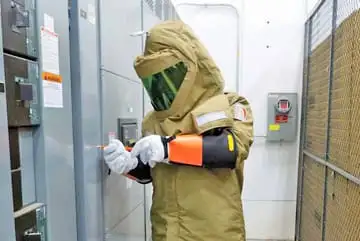
When companies prepare for compliance, safety managers often compare PPE options using resources such as our detailed guide to arc-rated clothing and a practical overview of selecting a 40 cal arc-flash suit.
OSHA’s lockout/tagout standard, formally known as the “control of hazardous energy,” remains the agency’s fifth most frequently cited standard. The regulation is designed to protect workers from severe injuries, including amputations, electrocution, burns, and crushed or fractured body parts, during machine cleaning, maintenance, and repair.
Electricians who perform maintenance on energized systems rely on step-by-step methods, such as the procedures outlined in 7 steps to arc flash analysis, supported by deeper technical data in our arc flash calculator.
The enforcement announcement comes as federal and state agencies address broader occupational health concerns. The California Department of Public Health (CDPH) issued an advisory on November 17, urging healthcare providers to prepare for an increase in silicosis cases. The California Division of Occupational Safety and Health (Cal/OSHA) made its emergency respirable crystalline silica (RCS) standard permanent last year, and silicosis became a reportable disease in June.
CDPH has confirmed 432 cases of silicosis among California countertop fabrication workers since 2019, including 25 deaths and 48 lung transplants. Cal/OSHA reported issuing citations in roughly 95% of its silica-related inspections over the past year.
Federal OSHA continues its 2023 enforcement initiative targeting silica exposure in engineered stone fabrication, as part of its broader National Emphasis Program on respirable crystalline silica.
Related Articles