Fault Current Limiter
Protective Relay Training - Basic
Our customized live online or in‑person group training can be delivered to your staff at your location.
- Live Online
- 12 hours Instructor-led
- Group Training Available
Download Our OSHA 4474 Fact Sheet – Establishing Boundaries Around Arc Flash Hazards
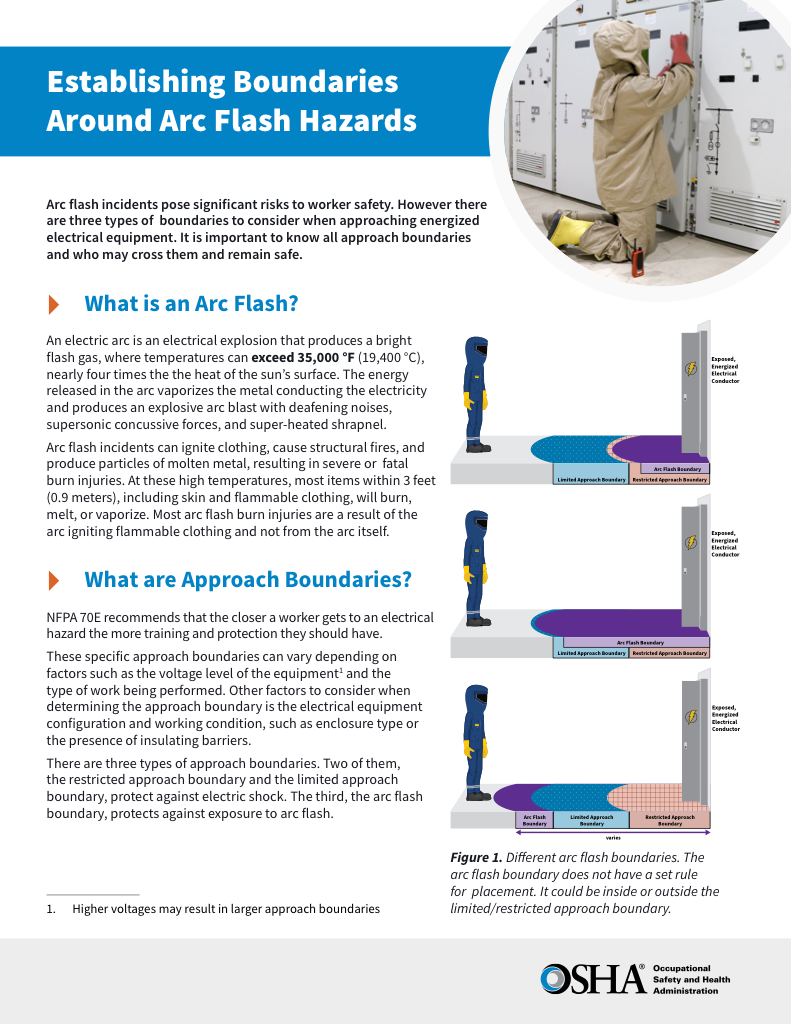
- Understand the difference between arc flash and electric shock boundaries
- Learn who may cross each boundary and under what conditions
- Apply voltage-based rules for safer approach distances
Fault current limiter technology reduces short-circuit current before it reaches damaging levels, protecting transformers, breakers, and modern grids where increased generation increases available fault current.
Understanding the Role of the Fault Current Limiter
In real power systems, fault current rarely becomes a concern until something changes. A plant expands, a second transformer is paralleled, onsite generation is added, or a utility network is tied together more tightly than before. Suddenly, available fault current jumps, and equipment that once sat comfortably within its ratings is operating closer to its limits than anyone expected. In many systems, fault current limiters are complemented by current limiting fuses, a relationship explored in more detail in our fuse technology and applications overview.
Basic Protection Relay Training
Request a Free Training Quotation
This is where a fault current limiter (FCL) earns its place. Rather than outright interrupting a fault, it constrains the event itself. By holding peak current to survivable levels, the limiter reduces mechanical stress, thermal damage, and the risk of cascading failures before breakers or other protective devices operate. Fault current limiters are often evaluated alongside broader protection strategies, and our overview of power system protection helps place them in context with relays, breakers, and other protective devices. For engineers trying to preserve existing infrastructure while accommodating growth, that restraint can be more valuable than outright interruption.
In modern grids, especially those integrating distributed and renewable sources, fault current limiters also help stabilize systems that no longer behave as simply as they once did. Traditional protection assumptions do not always hold in mixed-source environments, and limiting fault contribution at the source can restore predictability to protection schemes that would otherwise become fragile. A comprehensive overview of circuit protection devices helps explain the role of Fault Current Limiters within the broader electrical protection strategy.
Sign Up for Electricity Forum’s Electrical Protection Newsletter
Stay informed with our FREE Electrical Protection Newsletter — get the latest news, breakthrough technologies, and expert insights, delivered straight to your inbox.
How Does a Fault Current Limiter Work?
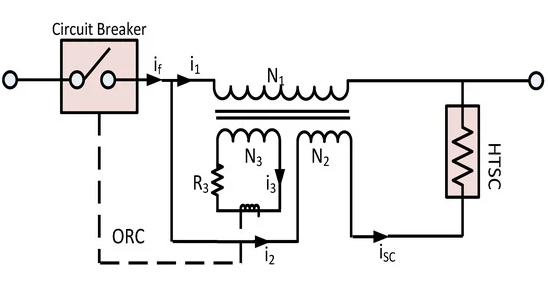
During a short circuit, current rises far faster than most equipment can tolerate. A fault current limiter intervenes at that moment by increasing the circuit impedance, effectively flattening the peak before it reaches destructive levels. Under normal operation, the device remains electrically unobtrusive, introducing little loss or disruption.
Different technologies achieve this effect in different ways. Some rely on passive electrical properties, while others respond dynamically to changing conditions. Superconducting designs, in particular, behave almost invisibly until a fault occurs, then transition rapidly as resistance increases. That speed is not academic. In high-power systems, milliseconds can separate a manageable event from permanent damage. Accurate fault current calculation is essential for selecting the proper protection devices, including FFault Current Limiters, to ensure safe system operation.
Because limiters shape the fault rather than clearing it, they work in concert with conventional protection rather than replacing it. Breakers still trip. Fuses still operate. The difference is that they do so under far less extreme conditions. Because fault current directly affects device ratings and protection margins, engineers must account for available fault current when deciding whether current limiting solutions are necessary.
Types of Fault Current Limiters
Not all FCLs are built for the same job, and their differences matter in practice.
Superconducting designs are often chosen for systems with high fault rates and critical response time. Their ability to remain effectively lossless during normal operation while reacting almost instantaneously to faults makes them attractive for dense networks and modern grids.
Solid-state limiters use power electronics to detect and limit abnormal current flow. They offer precision and speed, which can be advantageous in medium-voltage applications where coordination margins are tight, and response consistency is essential. They also affect how traditional short-circuit protection devices operate, particularly in systems where fault energy would otherwise exceed equipment capabilities.
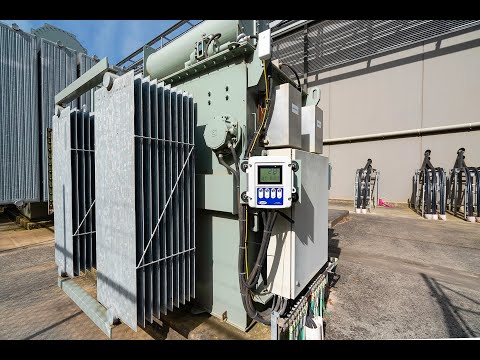
Inductive limiters take a simpler, more traditional approach by adding impedance through magnetic means. While they lack the sophistication of newer technologies, they remain effective in environments where robustness and predictability are valued over ultra-fast response.
How Does a Fault Current Limiter Improve System Protection?
One of the less obvious benefits of limiting fault current is the change it causes in system-wide stress. Lower peak currents mean reduced mechanical forces on buswork, less heating in transformer windings, and fewer violent interactions inside breakers during fault clearing. Over time, that reduction translates into longer equipment life and fewer unexplained failures.
Without current limiting, engineers are often forced to oversize equipment to survive worst-case faults. That approach increases cost, footprint, and complexity. By managing fault energy instead of brute-forcing it, limiters allow systems to remain efficient while still meeting protection requirements.
They also preserve coordination. Protection settings that would otherwise need to be revisited after every system change can often remain valid when fault levels are controlled at the source. For engineers responsible for protection schemes, a deeper understanding of relays is essential, and our overview of what is electrical protection helps tie current limiting concepts back to first principles.
Related Articles