Major investments by Canada and Quebec in electric vehicle battery assembly
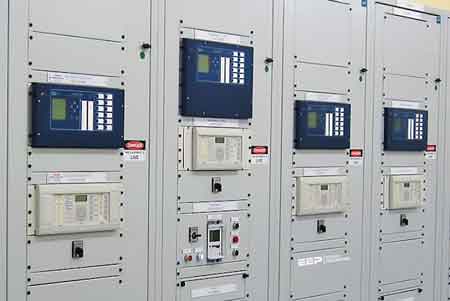
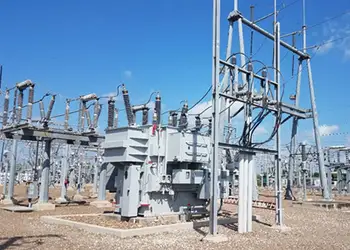
Substation Relay Protection Training
Our customized live online or in‑person group training can be delivered to your staff at your location.
- Live Online
- 12 hours Instructor-led
- Group Training Available
Lion Electric Battery Plant Quebec secures near $100M public investment for an automated battery-pack assembly in Saint-Jérôme, fueling EV manufacturing, R&D, local supply chains, and heavy-duty zero-emission vehicle competitiveness and jobs.
Story Summary
Automated battery-pack plant in Saint-Jérôme boosting EV manufacturing and strengthening Quebec's supply chain.
Equal federal and Quebec support totals nearly $100M for Lion Electric.
$185M project builds automated battery-pack assembly in Saint-Jérôme.
135 jobs at 2023 commissioning; about 150 more expected longer term.
Supplies Lion medium and heavy-duty zero-emission commercial vehicles.
Onsite R&D center advances battery design, performance, and supply chains.
Canadian Prime Minister of Canada, Justin Trudeau, and the Premier of Quebec, François Legault, have announced an equal investment totalling nearly $100 million to Lion Electric, as a B.C. battery plant announcement has done in another province, for the establishment of a highly automated battery-pack assembly plant in Saint–Jérôme, in the Laurentians. This project, valued at nearly $185 million, will create 135 jobs when construction of the plant is completed in 2023. It is also expected that 150 additional jobs will be created over the longer term.
For the announcement, Mr. Trudeau and Mr. Legault were accompanied by the Minister of Innovation, Science and Industry, François-Philippe Champagne, by Quebec's Minister of Economy and Innovation, Pierre Fitzgibbon, and by Marc Bédard, President and Founder of Lion Electric.
The battery packs assembled at the new plant will be used in Lion Electric vehicles. This strategic investment will allow the company to improve its cost structure, and better control the design and shape of its batteries, making it more competitive in the heavy-duty electric vehicle market, as EV assembly deals put Canada in the race. Ultimately, the company will be able to increase the volume of its vehicle production. Lion Electric will be the first Canadian manufacturer of medium and heavy-duty vehicles to have state-of-the-art, automated battery-pack manufacturing facilities.
The company will also establish a research and development innovation centre within its manufacturing plant, which will allow it to test and refine products for future use, including batteries for emergency vehicles such as ambulances. The company will test innovations from research and development, including energy storage capacity and battery performance. The results will make these products more competitive in the North American market, where a Niagara Region battery plant signals growing demand.
The company said it expects to employ 135 people at the plant when it is operational by 2023. It also plans to invest in a research and development facility that could create a number of spinoff jobs.
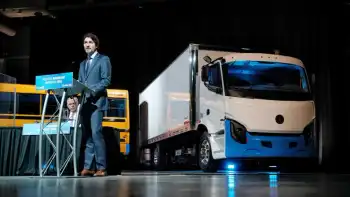
"When we talk about an economic recovery that's good for workers, for families and for the environment, this is exactly the kind of project we mean," Trudeau said at a news conference in Montreal.
Trudeau toured Lion Electric's factory in Saint-Jérôme, Que., last March, just before the pandemic. (Ryan Remiorz/The Canadian Press)
It was the prime minister's first trip to Montreal in more than a year. He said one of the reasons he decided to attend the announcement was to illustrate the importance of the green economy and how Canada can capitalize on the U.S. EV pivot for future job growth.
The project also aligns with the Legault government's desire to create a supply chain within Quebec that is able to feed the electric vehicle industry, where Canada-U.S. collaboration could accelerate progress.
At Monday's announcement, Economy Minister Pierre Fitzgibbon spoke at length about the province's deposits of lithium and nickel — key components in electric vehicle batteries — as well as its supply of low-emission hydroelectricity.
"If we play our cards right, we could become world leaders in this market of the future," Fitzgibbon said.
Currently, many of those strategic minerals found in Quebec are exported to Asia where they are turned into battery cells, and then imported back to Quebec by companies like Lion, said Mickaël Dollé, a chemistry professor at the Université de Montréal.
By opening a battery assembly plant in Quebec, Lion could help stimulate more cell-makers, such as the Northvolt project near Montreal, to set up shop in the province. Further localizing the supply chain, Dollé said, means better value and a greener product.
But other countries have the same goal in mind, he said, and the window for the province to establish itself as an important player in the emerging electric vehicle battery industry is closing quickly, as major Ford Oakville deal commitments accelerate competition.
"The decision has to be taken now, or in the coming months, but if we wait too long we may miss our main goal which is to get our own supply chain in Canada," Dollé said.
What's in a name?
Monday's announcement was closely watched in Quebec for what it foretold about the political future as well as the economic one.
By coming to Montreal and touring a vaccination clinic before making the funding announcement, Trudeau fed speculation in the province that he is preparing to call an election soon.
Intrigue also surrounded the informal meeting Trudeau had with Legault on Monday. The Quebec premier and members of his government have repeatedly expressed frustration with Trudeau during the pandemic.