Four-Year U.S. Wind Forecast Sees Quarter-Million Jobs

CSA Z462 Arc Flash Training – Electrical Safety Compliance Course
Our customized live online or in‑person group training can be delivered to your staff at your location.

- Live Online
- 6 hours Instructor-led
- Group Training Available
American Wind Power Expansion drives 248,000 jobs, $85B economic activity, 35 GW capacity growth, boosting manufacturing, rural communities, and tax revenues, supported by the PTC and record renewable energy deployment through 2020.
Main Details
American Wind Power Expansion adds 35 GW by 2020, fueling 248,000 jobs and $85B in U.S. economic activity.
35 GW new capacity from 2017-2020 across rural America
Projected 248,000 jobs; 33k in factories, 114k in O&M
Generates $8B taxes; $85B total economic activity
The expansion of American wind power, as recent grid data show across the U.S., is poised to drive 248,000 jobs and $85 billion dollars in economic activity over the next four years, according to the American Wind Energy Association (AWEA), citing a new report from Navigant Consulting.
These and other economic benefits will result from the addition of 35 GW of new wind power capacity through the end of 2020, even as the timeline to reach 1 GW of U.S. offshore wind remains uncertain for grid connection, which also mark’s the end of President Donald Trump’s term in office, AWEA says.
AWEA has released an accompanying white paper. “Wind brings jobs and economic development to all 50 states,” to highlight the economic benefits wind already delivers to the U.S. economy today. For the first time ever, the U.S. wind industry supports more than 100,000 jobs; in fact, there are 102,500 workers in all 50 states.
“Growing wind energy revitalizes America’s rural areas and Rust Belt manufacturing centers,” comments Tom Kiernan, CEO of AWEA. “With over 100,000 jobs today, the industry is just getting started. This new analysis projects the industry could drive nearly a quarter-million jobs by 2020 – with $85 billion in economic activity over the next four years alone.”
AWEA says American wind industry jobs grew nearly 17% during 2016, and Navigant expects this growth to continue: Through 2020, the consultant expects a total of 248,000 wind-related American jobs, including induced jobs. By that time, there would be 33,000 Americans working in factories supplying the wind industry; 114,000 Americans building, operating and maintaining wind turbines; and an additional 102,000 workers in jobs supported by the industry.
The 102,500 wind industry jobs previously documented by AWEA include Americans working only for wind companies or in their supply chain in 2016 (not jobs in supporting industries). And unlike previous AWEA figures reporting the amount of private investment in new turbines each year, the Navigant study incorporates additional economic activity from operating and maintaining wind turbines, payments to landowners, and taxes paid by the wind industry, AWEA points out.
Rural areas that sorely need investment will be the largest beneficiaries of this growth, as illustrated by new Midwestern wind projects that attract capital, considering 99% of wind projects are located in rural areas today, the association says.
Wind power development funds states and local communities through sales, income and property taxes, and Navigant calculates that the new wind activity will pay over $8 billion in taxes over the next four years – on top of the tax revenues from existing wind projects. These tax revenues help local communities fix roads, build schools and improve emergency services, notes AWEA.
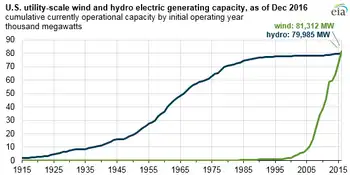
As pointed out in a recent AWEA report, wind is now the largest source of renewable energy capacity in the U.S., and the most-used renewable for generation across the country: At the end of 2016, there was more than 82 GW installed. Now, Navigant’s forecast for the development of 35 GW of additional wind power capacity between 2017 and 2020 represents a more than 40% increase.
According to the consultant, this growth is made possible, in part, by the multiyear extension of the wind energy production tax credit (PTC) in 2015, though some analysts caution in a report on Solar ITC impacts that policy shifts could challenge wind competitiveness in coming years. The credit has already begun phasing out on an 80%-60%-40% schedule, starting this year, and by 2019, wind will be the only major source of energy without a dedicated federal incentive.
“American ingenuity and hard work have driven the cost of wind down by two-thirds since 2009, propelling wind to contribute 30 percent of power plant capacity added over the last five years,” Kiernan adds. “The policy certainty provided by the 2015 production tax credit phase-down has allowed the industry to make long-term investments in the American workforce and manufacturing to further bring costs down.”