Vertical AI for Utilities: Solving the High-Bill Crisis in Ways Your Legacy AI Tools Can’t
By Gautam Aggarwal, Chief Revenue Officer at Bidgely
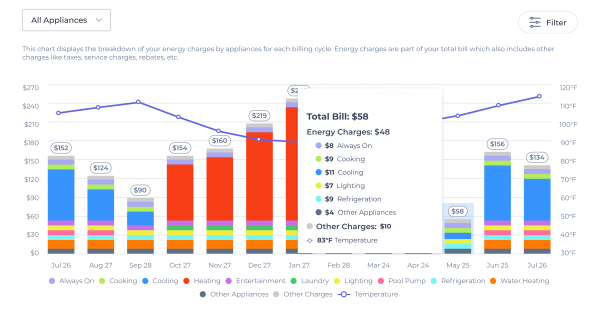
Vertical AI helps utilities explain high energy bills by turning smart meter data into appliance level insights, cutting call handle time, improving first call resolution, and restoring customer trust.
The headlines are everywhere, and utility customers are feeling the pinch. A recent poll found that 62 percent of Americans are seeing their energy bills jump, and a staggering 73 percent fear those costs will keep climbing. This isn't just an inconvenience, it's a crisis of confidence for utilities.
When a customer gets a high bill, their first reaction is to call you. This surge in calls chokes utility customer service reps (CSRs), dragging down efficiency and eroding hard-won trust. Why? Because the standard kilowatt-hour (kWh) total on a monthly statement is lacking insights into the most urgent question: "Why is my bill so high, and what can I do about it?"
Right now, utility CSRs are forced to become data detectives, manually piecing together fragmented clues—meter reads, billing history, and weather—from disparate systems. The result: slow, frustrating interactions, unhappy customers, and costly truck rolls. Better behind-the-meter intelligence delivered in the right context for high bill customers can help CSRs actively reduce average call handle time (AHT) and improve first-call-resolution rates.
For years, energy CIOs have done the right thing, investing in smart meters, robust customer information systems, and massive data lakes. But the one missing piece is a purpose-built engine to turn that massive data trove into real-world utility intelligence. The key to ending the high-bill deluge, and tackling bigger grid challenges, is moving past generic solutions to embrace “vertical AI.”
From Generic Chatbots to Industry-Native Intelligence
To truly master the high-bill issue, technology leaders must understand the crucial distinction between two types of AI:
-
Horizontal AI: These are the general-purpose tools designed to work across all sectors—think automated customer service bots. They're great for general tasks and broad business intelligence, but they lack the deep contextual knowledge of the energy industry.
-
Vertical AI: This is purpose-built for utilities. Vertical AI solutions integrate deep energy company context within the utility’s own cloud environment, enabling predictive insights for the grid, customized customer interactions, and improved operational risk management.
Vertical AI is the missing link. It transforms isolated utility data into actionable intelligence that drives end-to-end use cases, from the call center to grid reliability. It is an evolution that finally enables CIOs to truly operationalize AI across their entire enterprise.
The High-Bill Solution: Transparency in Seconds
Vertical AI offers the first scalable path to empowering utility frontline CSRs with real-time, appliance-level consumption intelligence. Instead of fumbling through a half-dozen systems, CSRs access a single, definitive dashboard that provides a personalized breakdown of a customer's energy use.
The difference lies in the technology's ability to break down the total consumption of a home and attribute it to major end-uses, such as heating and cooling, water heating, and always-on devices.
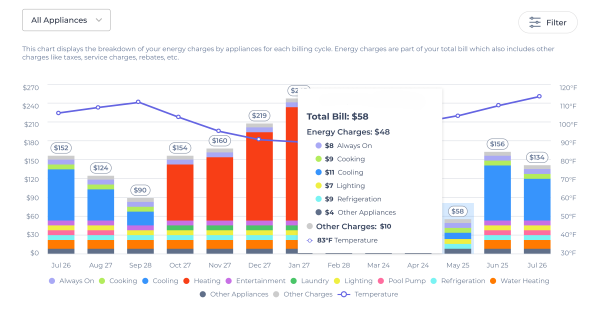
When a panicked customer calls, the CSR can instantly provide a data-backed, transparent answer: "Your increase this month wasn't a mistake. It was due to your HVAC usage increasing by 35 percent because the night temperatures averaged 10 degrees lower than last year."
This level of detail dramatically cuts call handling times, slashes the need for expensive onsite visits, and, most importantly, transforms an instance of customer frustration into a moment of trust and education.
Field-Proven Impact: Utilities Transforming Customer Trust
Across diverse service territories, utilities are proving the success of this approach by addressing high-bill calls with speed and accuracy.
Middle Tennessee Electric (MTE) serves approximately 350,000 members. MTE struggled with high-bill complaints from members using electric strip heat who insisted they hadn't changed their thermostat settings. Their old system only showed total kWh. Now, with vertical AI, CSRs can visualize appliance-level information on increased heating usage. They can clearly explain how this less-efficient heating method automatically activates when temperatures drop, causing an unexpected consumption spike. This kind of data-backed explanation helps build trust.
Central Electric Cooperative (CEC), the largest co-op in Oregon, serves over 30,000 members and prioritizes first-call resolution. However, the rise of electric vehicles (EVs) and heat pumps made answering high-bill questions very challenging. Vertical AI lets the CSRs immediately present the customer with a personalized, device-by-device breakdown of their energy use, pinpointing the exact driver of the cost increase. This adds a new, necessary level of transparency and confidence.
Beyond the Bill: Vertical AI as the Enterprise Foundation
Solving the high-bill issue is critical, but it's only the immediate win. Vertical AI is the foundation for the energy utility of the future. The same secure, granular intelligence powering the call center can extend its value across the entire enterprise:
-
Grid Planning and Load Management: Planners gain access to granular consumption data, allowing them to accurately forecast loads from high-growth assets like EVs and distributed energy resources (DERs). This insight is crucial for smarter program design and deferring costly infrastructure upgrades.
-
Targeted Efficiency Programs: Vertical AI automatically identifies the most inefficient units and high-consumption homes, enabling precision targeting for energy efficiency and rebate programs. For low-to-moderate income (LMI) members, this ensures resources are directed to high-impact interventions like weatherization, maximizing long-term savings.
-
Quantifying Program ROI: Programmatic teams gain a quantifiable view of conservation potential. Vertical AI allows utilities to accurately measure the actual energy savings impact of all programs and fulfill regulatory requirements by treating efficiency as a verifiable, cost-effective resource.
By bridging the gap between isolated smart meter data and enterprise-wide strategic decisions, vertical AI establishes the core digital framework necessary to navigate the complexities of electrification and decentralized generation. From converting anxious high bill customers into active program participants, to enabling enterprise impact, industry-native intelligence is now imperative to truly drive operational value and maintain the public trust that is foundational to the utility business.
For more information, contact: info@bidgely.com.