Electrical Arc Flash
By William Conklin, Associate Editor

CSA Z462 Arc Flash Training – Electrical Safety Compliance Course
Our customized live online or in‑person group training can be delivered to your staff at your location.
- Live Online
- 6 hours Instructor-led
- Group Training Available
Download Our OSHA 4475 Fact Sheet – Being Aware of Arc Flash Hazards
- Identify root causes of arc flash incidents and contributing conditions
- Apply prevention strategies including LOTO, PPE, and testing protocols
- Understand OSHA requirements for training and equipment maintenance
Electrical arc flash is a high-energy hazard from fault currents, releasing intense heat and pressure; NFPA 70E compliance, PPE, incident energy analysis, arc flash boundaries, and labeling support risk assessment and mitigation in switchgear.
Electrical Arc Flash and Its Impact on Workplace Safety
Electrical arc flash is one of the most severe hazards found in energized electrical systems. Unlike shock hazards, which require direct contact with live conductors, an electrical explosion develops when fault current travels through the air, releasing extreme heat and force in a fraction of a second.
These electrical explosions most often occur in switchgear, motor control centers, panelboards, and industrial power distribution equipment, where normal tasks can quickly escalate into life-altering incidents if conditions align. To understand when these events are most likely to occur, review the circumstances under which an arc flash can occur to support risk assessments.
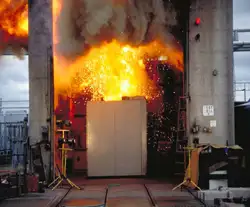
An electrical blast can generate temperatures exceeding 35,000 degrees Fahrenheit at the point of the arc, hot enough to vaporize metal instantly. The rapid expansion of superheated air and metal creates a powerful pressure wave, producing what is commonly called an arc blast. Together, heat, light, sound, and pressure create conditions capable of causing life-altering injuries within milliseconds.
Why Electrical Arc Flash Is So Dangerous
During an event, energy is released faster than the human body can respond. Workers in close proximity may suffer deep thermal burns, ignition of clothing, vision damage from intense light, and hearing loss from the explosive sound pressure. Molten metal and shrapnel can be expelled outward, increasing the risk of secondary injuries even at distances beyond the arc itself. Technicians and supervisors benefit from clarifying how an arc flash occurs before drafting or updating procedures.
FREE EF Electrical Training Catalog
Download our FREE Electrical Training Catalog and explore a full range of expert-led electrical training courses.

- Live online and in-person courses available
- Real-time instruction with Q&A from industry experts
- Flexible scheduling for your convenience
Because these hazards are predictable and measurable, modern electrical safety standards emphasize prevention rather than reaction. NFPA 70E in the United States and CSA Z462 in Canada establish the framework for identifying electrical safety risk and controlling exposure through engineering analysis, labeling, and work practices.
An arc fault occurs when electricity unintentionally jumps from its normal path, creating a connection through air to ground or another voltage phase in an electrical system, which can trigger a dangerous electrical explosion or discharge. Common causes of accidents include equipment deterioration, loose connections, dropped tools, and human error during energized work.
This type of electrical explosion releases intense heat, pressure, and light in a fraction of a second, dramatically increasing the risk of explosion for anyone nearby. Because these events develop faster than a person can react, properly selected personal protective equipment ppe and disciplined work practices play a critical role in reducing injury when hazards cannot be fully eliminated.
Standards and Regulatory Guidance
NFPA 70E was developed to address electrical hazards in the workplace by translating electrical system behavior into actionable safety controls. It requires employers to evaluate risk, define approach boundaries, calculate incident energy, and select appropriate personal protective equipment. CSA Z462 serves the same function in Canada and closely mirrors NFPA 70E requirements.
These standards do not assume all energized work carries equal risk. Instead, they rely on system-specific data to determine where hazards exist and how severe the potential exposure may be. This approach allows safety decisions to be based on engineering analysis rather than generalized assumptions.
Common Causes of Electrical Arc Flash
Events rarely stem from a single factor. Most incidents result from a combination of conditions, including:
-
Equipment failure caused by aging components, insulation breakdown, or mechanical damage
-
Accidental contact with energized parts, often involving tools or test probes
-
Improper installation, such as loose connections, poor grounding, or incorrect protective device settings
-
Human error, including procedural shortcuts, miscommunication, or inadequate training
-
Environmental influences such as dust, moisture, corrosion, or conductive contamination
Understanding these causes is essential for reducing risk. Many incidents occur during routine tasks such as testing, troubleshooting, or maintenance, especially when equipment remains energized.
The Physical Nature of an Arc Flash Event
An electrical arc flash occurs when current leaves its intended conductive path and bridges an air gap. Once initiated, the arc sustains itself in ionized air, rapidly intensifying. The amount of energy released depends on the available fault current, the protective device's clearing time, the equipment configuration, and the working distance.
In addition to thermal injury, events can cause long-term health effects. Survivors may experience permanent hearing damage, vision impairment, or traumatic injuries caused by the pressure wave. These outcomes reinforce why arc blast and flash are treated as both a thermal and mechanical hazard under safety standards.
Protecting Yourself from Electrical Arc Flash
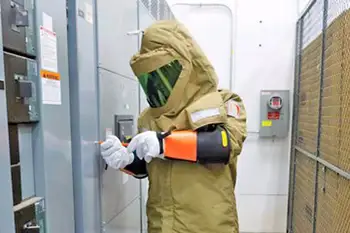
Reducing the risk of injury and death begins with eliminating exposure wherever possible. De-energizing equipment before work remains the most effective control. When energized work cannot be avoided, layered protection becomes critical.
Effective protective measures include:
-
Using arc-rated personal protective equipment selected based on the calculated incident energy
-
Following lockout and verification procedures before maintenance or servicing
-
Maintaining safe working distances defined by boundaries
-
Using insulated tools and properly rated test instruments
-
Ensuring workers receive task-specific electrical safety training
-
Performing regular inspections and maintenance to identify emerging hazards
Electrical personal protection is not a single control but a coordinated system of analysis, procedures, training, and equipment.
Electricity Today T&D Magazine Subscribe for FREE

- Timely insights from industry experts
- Practical solutions T&D engineers
- Free access to every issue
Closing Perspective
Arc flash remains one of the most serious threats in industrial and commercial electrical environments, yet it is also among the most preventable. By applying incident energy analysis, enforcing standards such as NFPA 70E and CSA Z462, and maintaining disciplined work practices, organizations can significantly reduce the likelihood and severity of injuries. Safety improves when hazards are understood, measured, and addressed before work begins.
Related Articles
