Tunisia invests in major wind farm as part of longterm renewable energy plan
CSA Z462 Arc Flash Training – Electrical Safety Compliance Course
Our customized live online or in‑person group training can be delivered to your staff at your location.

- Live Online
- 6 hours Instructor-led
- Group Training Available
Sidi Mansour Wind Farm Tunisia will deliver 30 MW as an IPP, backed by UPC Renewables and CFM, under a STEG PPA, supporting 2030 renewable energy targets, grid connection, job creation, and CO2 emissions reduction.
Essential Takeaways
A 30 MW wind IPP by UPC and CFM in Sidi Mansour, supplying STEG and advancing Tunisia's 2030 renewable target.
30 MW capacity; expected to cut CO2 by up to 56,645 t annually
Among Tunisia's first wind IPPs under the Authorisation Scheme
PPA signed with STEG; grid connection and permitting led by UPC
CFM co-developer providing lifecycle financing and advisory services
UPC Renewables (UPC) and the Climate Fund Managers (CFM) have partnered to develop a 30 megawatt wind farm in Sidi Mansour, Tunisia, which, amid regional wind expansion efforts, will help the country meet its 30% renewable energy target by 2030.
Tunisia announced the launch of its solar energy plan in 2016, with projects like the 10 MW Tunisian solar park aiming to increase the role of renewables in its electricity generation mix ten-fold to 30%,
This Sidi Mansour Project will help Tunisia meet its goals, reducing its reliance on imported fossil fuels and, mirroring 90 MW Spanish wind build milestones, demonstrating to the world that it is serious about further development of renewable energy investment.
“Chams Enfidha”, the first solar energy station in Tunisia with a capacity of 1 megawatt and located in the Enfidha region. (Ministry of Energy, Mines and Energy Transition Facebook page)
This project will also be among the country’s first Independent Power Producers (IPP). CFM is acting as sponsor, financial adviser and co-developer on the project, in a landscape shaped by IRENA-ADFD funding in developing countries, while UPC will lead the development with its local team. The team will be in charge of permitting, grid connection, land securitisation, assessment of wind resources, contract procurement and engineering.
UPC was selected under the “Authorisation Scheme” tender for the project in 2016, similar to utility-scale developments like a 450 MW U.S. wind farm, and promptly signed a power purchase agreement with Société Tunisienne Electricité et du Gaz (STEG).
Brian Caffyn, chairman of UPC Group, said: “We can start the construction of the Sidi Mansour wind farm in 2020, helping stimulate the Tunisian economy, create local jobs and a social plan for local communities while respecting international environmental protection guidelines.”
Sebastian Surie, CFM’s regional head of Africa, added: “CFM is thrilled to partner with a leading wind developer in the Sidi Mansour Wind Project to assist Tunisia in meeting its renewable energy goals. As potentially the first Wind IPP in Tunisia, this Project will be a testament to how CI1’s full life-cycle financing solution can unlock investment in renewable energy in new markets, as seen in an Irish offshore wind project globally.”
The project will not only provide electricity, but also reduce CO2 emissions by up to 56,645 tonnes and create some 100 new jobs.
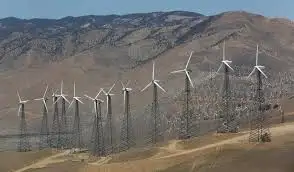
Wind turbine in El Haouaria, Tunisia, highlighting advances such as a huge offshore wind turbine that can power 18,000 homes. (Reuters)
Tunisia’s first power station, “Chams Enfidha,” inaugurated at the beginning of July, has a capacity of one megawatt, with an estimated cost of 3.3 million dinars ($1.18 million). The state invested 2.3 million dinars into the project ($820,000), with the remaining 1 million dinars ($360,000) provided by a private investor.